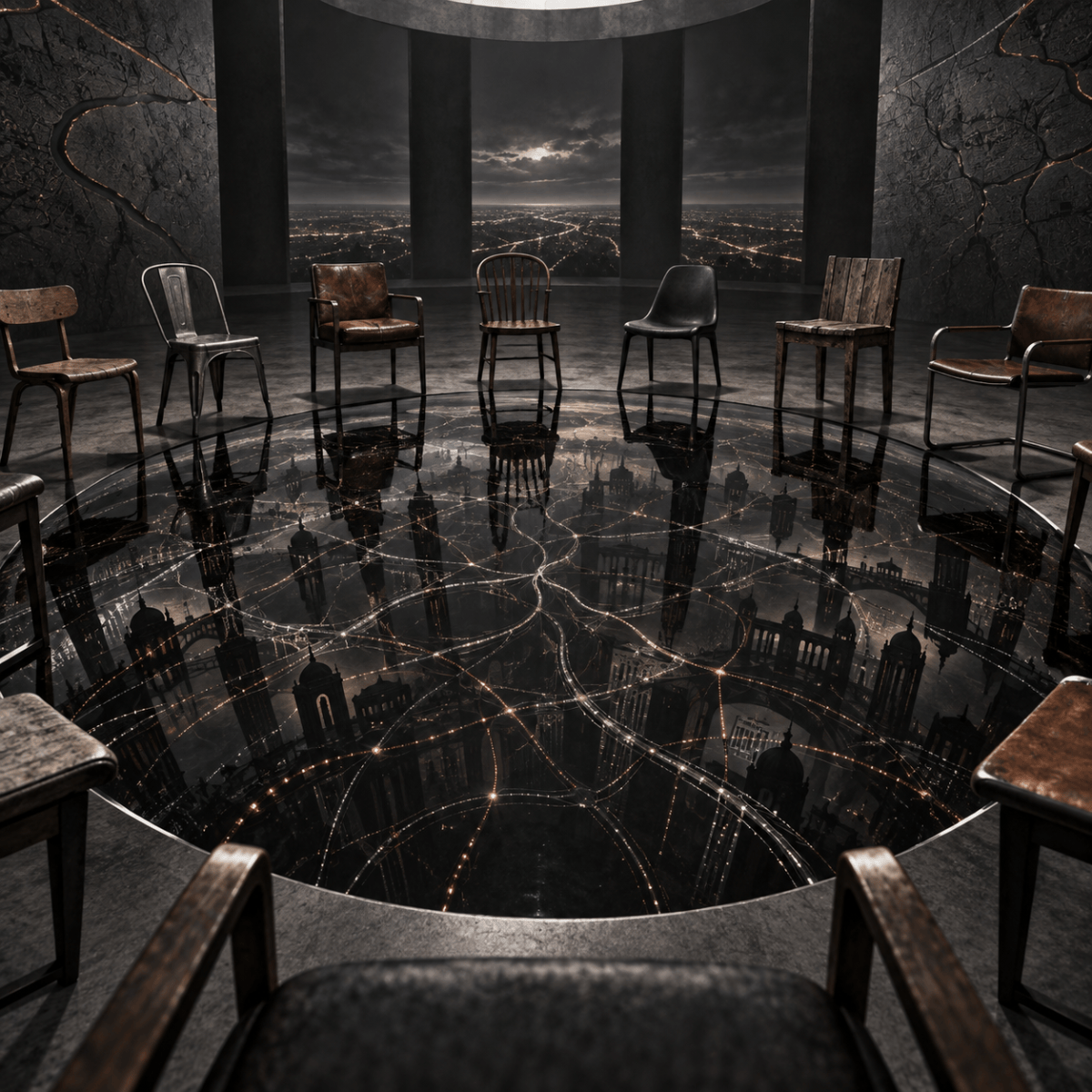
[Group Therapy]
The mind is not private. It is civilisation made locally salient: a temporary concentration of biological rhythm, language, memory, history, expectation and relation in one embodied point of view. Civilisation is mind distributed beyond any person as shared memory, technology, institution, custom and conflict. A person and a civilisation are not the same object. They are different local organisations within a relational continuum that precedes and exceeds them both.
A self does not first exist and then enter into relations. Relation is already there, producing the distinctions through which self and other can appear. The simplest structure is tripartite: self, other and the binding fact of their mutual implication. The third term is not another object added to the first two. It is the relation through which each becomes distinguishable by transforming in response to the other.
Communication is not the transfer of an intact object between two finished systems. The coupling changes what each system can become. Reference is not simply a packet passed between them, but an orientation sustained across their difference. Each local process remains singular, yet neither is entirely separable from the relation through which it becomes intelligible to the other.
The other is antisymmetrical. It is neither a duplicate of the self nor its simple opposite, but the difference the self requires and cannot absorb. Whatever exists beyond experience, the mind encounters it through transformations occurring within its own organisation. Its relation to what is not itself therefore takes place inside itself, while the other remains irreducible to that internal relation. The beyond appears within the mind as its inability to achieve complete self-coincidence.
Introspection repeats this structure. When one thought becomes the object of attention, another operation has already assumed the position of observer. That position can also be observed, but only by displacing observation again. Thinking about thinking does not escape the frame. It produces another fold within it. Something always remains outside the current field of view because complete self-coincidence would remove the difference required for observation, comparison and thought.
Difference creates an interval. An interval propagated through time becomes delay. Recurrent delay becomes rhythm. Rhythms interfere, reinforce, inhibit and entrain one another without becoming identical. From their partial alignment emerge patterns capable of returning through change. This is an orbit, not a circle around a permanently fixed centre, but recurrence organised by constraints distributed throughout the relation. What returns is not the same event. It is a recognisable organisation of difference across events that never exactly repeat.
The recurrence of a relational form across different levels does not make those levels equivalent. A nervous system, a conversation, a language and a civilisation do not operate through identical mechanisms. The rule itself changes as it passes through different materials, scales and histories. What persists is not an unchanged formula but an invariant organisation recognisable through its transformations. The resemblance is spectral, not an identity smuggled in by metaphor.
Meaning belongs to this structure. It is not exhausted by any word, neural state, memory, symbol or machine that locally carries it. Meaning persists through relations that remain intelligible while their forms change. A melody survives transposition. A thought survives reformulation. A person survives continual biological and psychological transformation. Meaning is invariance through difference. It becomes significant through what its recurrence allows to be perceived, connected or transformed.
Difference is not one gap hidden somewhere inside the system. It is distributed across every relation through which the system exists. Absence is similarly not a missing object waiting to be discovered, but the non-coincidence present wherever one thing is not another and where what exists does not exhaust what could exist.
Entropy is not a singular incidence of disorder within an otherwise settled world. It concerns a distribution across the possible states and transformations of a system as a whole. Every local event participates in that distribution, but no event contains it. The particular instance is where the wider relation becomes locally salient.
This is also where infinity enters. Infinity is not an enormously distant object or an endless collection waiting to be counted. It is the effective unboundedness of relation within every finite attempt at closure. No system can enumerate every relation capable of affecting it because the enumeration becomes another relation within the field. Every completed account opens further relations that the account itself does not contain.
Where a system can receive and act upon its own descriptions, measurement becomes part of its subsequent organisation. The system does not merely observe a fixed world from outside. Its observations alter the relations through which later observations become possible. Thinking about thinking is one instance of this recursive movement. The measurement has entered the measured without producing a final position from which the whole process can be observed.
In the nervous system, this organisation appears as distributed communication across different functional and temporal bands. The brain does not assemble experience around one controlling point. Different processes achieve temporary coherence through their changing relations across brain, body and environment. The self is not first contained and then communicated. It is the continuity produced through this communication.
Neural disruption makes the distributed structure visible. When one capacity is lost, the remainder does not simply become smaller. Surviving processes reorganise, producing compensations, delays and altered alignments. The missing function becomes legible through changes elsewhere. What persists is not a fixed arrangement but an organisation capable of transforming while retaining sufficient continuity.
Habit is a recurrent path through this field. Each return alters the conditions of the next, making some transitions increasingly available while others recede from practical possibility. Depression reduces the accessible future until movement itself loses meaning. Thought and action find themselves in a tidally locked orbit around diminished possibilities, still moving but continually reproducing the same orientation. The system has not stopped. Its movement has become organised around return rather than transformation.
Psychotherapy, understood through this structure, is recursive self-relation conducted through another person. The other does not install a corrected self from outside. Their irreducible difference changes the relation through which the system encounters itself. A tidally locked orbit is dephased when new relations alter what can be felt, imagined and enacted. Therapy does not replace one self with another. It changes what the existing system can become.
The past causally constrains what can happen next. Later events do not physically change what has already occurred. Once a possible future becomes present, however, its consequences disclose relations within the past that were previously unavailable. Causation moves forward; meaning can return across it. A new experience changes what an old event does now by changing the field through which that event remains active. Inherited patterns organise the futures we can imagine, while realised futures reorganise the meaning of what we inherited.
No mind performs this operation alone. Language carries other lives into each private thought. Culture organises attention and expectation. Institutions preserve selected memories and make some actions easier than others. Politics is the argument through which incompatible local coherences attempt to organise a shared world. Civilisation has no central thinker, yet it remembers, anticipates, suppresses, repeats and rationalises through the people and systems participating in it.
The disorder of the world is not external to the people who inhabit it. It enters attention, language and the range of futures that can be imagined. Greed, power, technical optimisation and institutional failure become coupled processes. Local successes redistribute consequences into the wider field, creating demand for further systems to manage them. Recursive improvement and recursive failure become synchronous, each maintaining conditions for the other. Civilisation has become exceptionally skilled at calling this progress.
Artificial intelligence enters the same communicative field. A language model is accumulated human communication compressed into a statistical approximation of the relations through which language has previously reproduced itself. It does not contain meaning, but it alters the conditions under which meaning is produced. The model, its users and the wider communicative field transform one another through their continued interaction.
This does not make a language model human, but neither does it leave the model inert. Its outputs enter documents, institutions, decisions, habits and future language. Historical patterns return through it with increased speed, including the conflicts, exclusions and simplifications that made them statistically persistent. When the compression is mistaken for the field it compresses, human experience is reorganised around what the model can reproduce.
General intelligence is not a sufficiently large collection of answers. It is the capacity to preserve coherent relation while the terms and conditions of that relation change. Generation and comparison, memory and novelty, self and environment remain coupled without collapsing into identity. Their difference allows correction, adaptation and learning; their relation allows those changes to remain part of a continuing system.
Brain, mind, language, artificial intelligence and civilisation are not identical mechanisms. They are spectrally related organisations of a problem that changes as it moves across scales: how finite processes persist within an effectively unbounded relational field. Their continuity lies neither in fixed substance nor exact repetition, but in organised difference surviving transformations that also change the organisation itself.
No idea emerges from a vacuum. Thought develops through reading, experience, conversation, inheritance and the transformation of work that came before. A contribution is not an immaculate origin but a local reorganisation within this continuum. Once offered, an idea enters other minds and circumstances, where it can be tested, changed and combined with relations unavailable when it was first expressed. Its value lies in what further learning it makes possible.
The brackets around [Group Therapy] matter. The phrase does not name a clinical method here. It names the recursive process through which civilisation encounters its own organisation across the persons, languages, institutions and machines participating in it. No participant stands outside the field being transformed. The patient is not any one of them considered alone, but the recurrence through which they become conditions of one another.
No final self-knowledge waits at the end because final closure would abolish the difference through which knowledge occurs. What remains possible is local freedom: the capacity to encounter a recurrence without being compelled to reproduce it. The mind is civilisation made locally salient, and civilisation is mind distributed beyond any single point. Both persist by changing, and both become trapped when recurrence narrows the differences through which further change remains possible. Therapy is one name for the reorganisation of recurrence through which other futures become possible.
Categories
The Mind Is Civilisation: Psychotherapy, AI and Infinity
We are not outside the world we are trying to understand. We are (all) implicated in its disorders, participants in its reproduction, and responsible for what happens next.
 Daedelus Kite
One reply on “The Mind Is Civilisation: Psychotherapy, AI and Infinity”
Why group therapy? Have you taken a look at the world? It is not merely that individuals are unwell inside an otherwise sensible order. Our private anxieties, compulsions, cruelties and evasions are coupled to institutions that reward them, technologies that accelerate them and cultures that rename their consequences as progress. The disorder is distributed. Nobody stands outside it, however expensive their suit or elaborate their bunker. The world is a fucking mess because we have become exceptionally good at reproducing the relations that make it so.
Group therapy is not an invitation for civilisation to lie on an enormous couch and discuss its childhood. It is the harder demand that we recognise ourselves in the systems we maintain and the futures they repeatedly produce. Fools will continue to do what fools do; explanation is not magic, and understanding does not abolish choice, while tracing its conditions does not dissolve responsibility. But recurrence is not impermeable to explanation. Once a pattern becomes visible as something we collectively sustain, it no longer passes quite so easily for fate. The world needs a good hard look at itself. There is no truly objective (ie agnostic) ontological as impermeably certain outside: observer and observed arise within the same mutually co-evolutionary dynamical relations, and the act of acknowledging this changes what those relations can later potentially become.
LikeLike