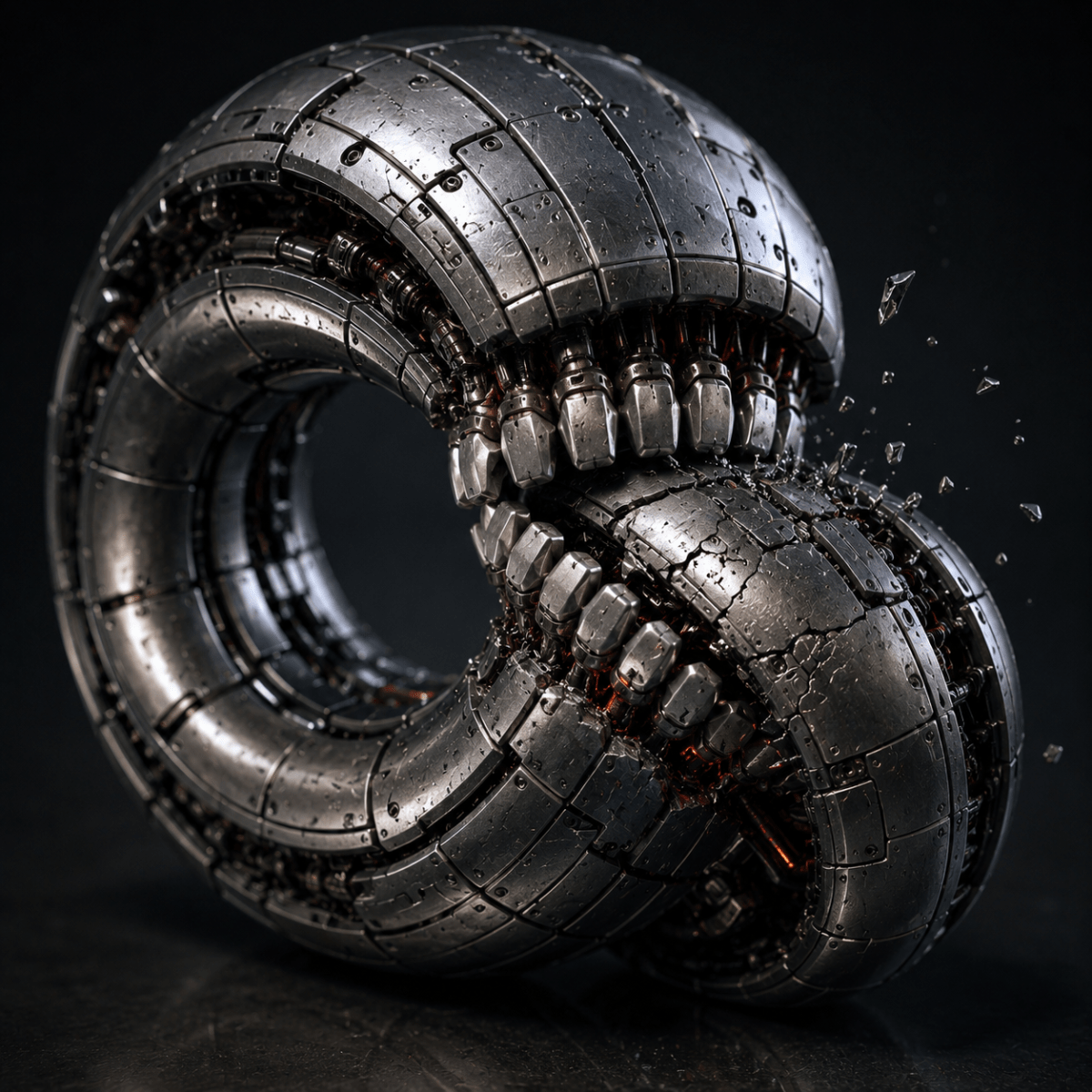
Technology has swallowed civilisation whole.
That statement sounds melodramatic until one begins listing the things modern societies can no longer do without. Food distribution. Energy grids. Banking. Logistics. Healthcare. Education. Communication. Navigation. Governance. Defence. Memory itself. The infrastructure through which modern life passes is now so thoroughly technological that removing it would not merely inconvenience civilisation. It would dissolve it.
Whether this outcome was inevitable is difficult to say. Complex societies appear to accumulate layers of organisation in much the same way cities accumulate roads or rivers accumulate tributaries. Every solution creates new opportunities. Every opportunity creates new dependencies. Over time those dependencies become structural. Eventually the distinction between society and the systems supporting society begins to blur. At some point technology ceased being a collection of tools. It became the environment within which human life increasingly unfolds.
This creates a peculiar asymmetry. Human beings evolved within small groups, bounded ecologies, and relatively local information environments. The systems now mediating human experience operate at planetary scale. They coordinate billions of people, process incomprehensible quantities of information, and shape behaviour through mechanisms that remain largely invisible to those participating within them. The mismatch is not merely technological. It is psychological, cultural, and political.
The consequences are now difficult to ignore. Loneliness rises amid unprecedented connectivity. Political volatility increases despite access to vast quantities of information. Public attention fragments. Trust erodes. Entire populations find themselves suspended between global systems too large to comprehend and local realities that increasingly feel beyond their control. We often describe these developments as separate crises. It is possible they are different expressions of the same underlying transition.
The concentration of wealth and influence around technological infrastructure is part of this story. So too are social media, artificial intelligence, surveillance systems, algorithmic governance, cyber conflict, and the increasingly strategic role of data itself. These are not isolated phenomena. They emerge from a civilisation whose critical functions now pass through interconnected technical systems. As those systems grow, so too does the significance of whoever owns, operates, regulates, or influences them.
What makes the situation unusual is that there is no obvious outside. Previous generations could imagine returning to an earlier arrangement. Industrial society could look backward to agriculture. Agricultural society could look backward to subsistence. Contemporary civilisation possesses no such horizon. The infrastructure has become too deeply embedded within the conditions of survival. The question is no longer whether we should use technology. The question is how a technological civilisation remains compatible with human flourishing once technology becomes the primary medium through which reality itself is encountered.
Perhaps this transition is simply another stage in the long history of human adaptation. Perhaps it is the unavoidable consequence of intelligence extending itself through tools. Perhaps it is neither good nor bad, but merely what happens when a species becomes capable of externalising memory, communication, coordination, and decision-making into increasingly autonomous systems.
What seems harder to dispute is that the centre of gravity has shifted. We no longer merely build technological systems. Technological systems increasingly build the conditions under which societies think, communicate, cooperate, compete, and understand themselves. The tools remain ours. The environment they have created increasingly is not.
Categories
all swallowed whole
Technology cannot solve itself, because the introspective incompleteness that limits it is a function of the same combinatorial unboundedness that makes it at all possible; spoiler: we humans are similarly and simultaneously bound by identical logic.


17 replies on “all swallowed whole”
LikeLike
技術は自らを解決できない。なぜなら、技術を制約する内在的な不完全性は、それを可能にしている無限の組み合わせ可能性そのものから生じているからだ。そして興味深いことに、人間もまた同じ論理の内側に生きている。
LikeLike
技术无法解决自身的问题,因为限制它的内在不完备性,恰恰源于使其成为可能的那种近乎无限的组合潜能。耐人寻味的是,人类同样身处这一逻辑之中。
LikeLike
技術無法解決自身的問題,因為限制它的內在不完備性,恰恰源於使其成為可能的那種近乎無限的組合潛能。耐人尋味的是,人類同樣身處這一邏輯之中。
LikeLike
기술은 스스로를 해결할 수 없다. 기술을 제한하는 내재적 불완전성은 그것을 가능하게 하는 거의 무한한 조합 가능성에서 비롯되기 때문이다. 흥미롭게도 인간 역시 같은 논리의 내부에 존재한다.
LikeLike
Công nghệ không thể tự giải quyết chính mình, bởi sự bất toàn nội tại giới hạn nó lại xuất phát từ chính khả năng kết hợp gần như vô hạn đã làm cho nó trở nên khả dĩ. Điều đáng chú ý là con người cũng tồn tại bên trong cùng một logic ấy.
LikeLike
Technologie kann sich nicht selbst lösen, weil die innere Unvollständigkeit, die sie begrenzt, aus derselben nahezu unendlichen Kombinationsvielfalt hervorgeht, die sie überhaupt erst möglich macht. Bemerkenswert ist, dass auch wir Menschen innerhalb derselben Logik existieren.
LikeLike
La technologie ne peut pas se résoudre elle-même, car l’incomplétude interne qui la limite provient de la même richesse combinatoire presque infinie qui la rend possible. Fait remarquable, nous autres humains existons également à l’intérieur de cette même logique.
LikeLike
La tecnología no puede resolverse a sí misma, porque la incompletitud interna que la limita surge de la misma capacidad combinatoria casi infinita que la hace posible. Lo más interesante es que los seres humanos también habitamos dentro de esa misma lógica.
LikeLike
A tecnologia não pode resolver a si mesma, porque a incompletude interna que a limita surge da mesma capacidade combinatória quase infinita que a torna possível. O mais interessante é que nós, seres humanos, também habitamos essa mesma lógica.
LikeLike
Технология не может разрешить саму себя, поскольку ограничивающая её внутренняя неполнота проистекает из той же почти бесконечной комбинаторной возможности, которая делает её возможной. Любопытно, что и люди существуют внутри той же логики.
LikeLike
لا تستطيع التكنولوجيا أن تحل نفسها، لأن النقص الداخلي الذي يقيّدها ينبع من الإمكانات التركيبية شبه اللامتناهية نفسها التي تجعلها ممكنة أصلاً. والأمر اللافت أن البشر أيضاً يعيشون داخل المنطق ذاته.
LikeLike
प्रौद्योगिकी स्वयं को हल नहीं कर सकती, क्योंकि उसे सीमित करने वाली आंतरिक अपूर्णता उसी लगभग असीम संयोजनात्मक क्षमता से उत्पन्न होती है जो उसे संभव बनाती है। रोचक बात यह है कि हम मनुष्य भी इसी तर्क के भीतर अस्तित्व में हैं।
LikeLike
Teknologi tidak dapat menyelesaikan dirinya sendiri, karena ketidaklengkapan internal yang membatasinya muncul dari kemungkinan kombinatorial yang nyaris tak terbatas, yang justru membuatnya mungkin ada. Menariknya, manusia juga hidup di dalam logika yang sama.
LikeLike
Teknoloji kendisini çözemez; çünkü onu sınırlayan içsel eksiklik, onu mümkün kılan neredeyse sınırsız birleşim olasılıklarından doğar. İlginç olan ise, insanların da aynı mantığın içinde var olmasıdır.
LikeLike
فناوری نمیتواند خود را حل کند، زیرا نقص درونیِ محدودکنندهٔ آن از همان ظرفیت ترکیبیِ تقریباً نامحدودی سرچشمه میگیرد که اساساً آن را ممکن میسازد. نکتهٔ جالب این است که ما انسانها نیز درون همین منطق زندگی میکنیم.
LikeLike
LikeLike