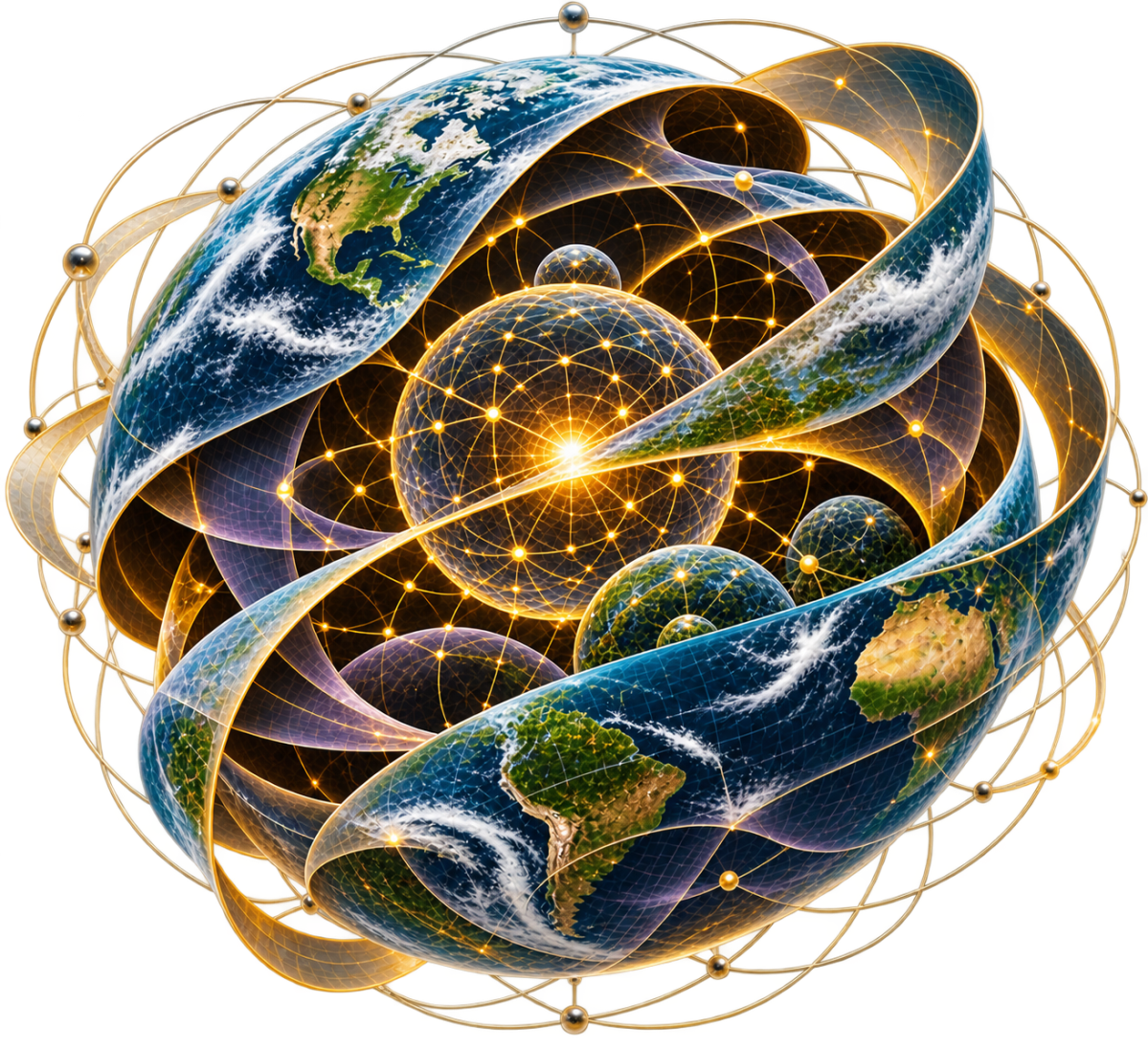
Field logic is an investigation into how things come into existence, sustain themselves and change through their relationships. Its foundational proposition is that the relationship of a thing to itself is constituted through its relationships with what it is not. Identity is a provisional continuity sustained through difference and interaction. Every explanatory system establishes distinctions that make its subject intelligible, yet drawing a boundary around something does not sever the relationships through which it exists. Field logic takes these peripheral dependencies as its conceptual centre, investigating the recursive relationships through which structures generate and sustain the conditions of their own existence. The logical orbit describes this mutual dependency. It is proto-logical because it concerns the emergence of both things and their relationships, rather than assuming either to exist independently. Its central proposition is that certain relational dynamics persist across transformations of scale, composition and context, offering a way into complexity without requiring an exhaustive description of its contents.
Climate change represents precisely the kind of problem towards which this investigation has been directed. Atmospheric chemistry, oceanic circulation, biodiversity, technological infrastructure, economic activity and cultural behaviour are reciprocally co-evolutionary processes, each transforming the conditions under which the others develop. Their cascading consequences generate a potentially unbounded complexity. Yet complexity is not merely an impediment to intervention; it is also the medium through which intervention propagates. The capacity for transformation resides not exclusively in the intervening agent but in the relationships through which an intervention acquires consequences. Field logic investigates how these relationships constitute and transform the participating systems themselves, and how the dynamics through which environmental degradation proliferates might be recruited into the propagation of ecological regeneration. It complements empirical climate modelling by examining the recursive dependencies between physical processes, their scientific representations and the social systems through which knowledge becomes action. What a model excludes may be constitutive of what it describes.
The limitations of existing approaches are not exclusively mathematical or computational. Academic institutions, political systems and commercial enterprises selectively reproduce forms of knowledge and practice compatible with their own persistence. This requires neither conscious suppression nor coordinated intent: the cumulative statistical effects of funding decisions, professional incentives, disciplinary boundaries and commercial dependencies progressively privilege particular ways of understanding the world. Intellectual orthodoxies emerge through the same recursive dynamics that sustain other complex structures. Institutions participate in generating conditions they subsequently describe as external problems, while their methods of investigating those problems remain subject to the requirements of institutional reproduction. Increasing the precision of scientific descriptions remains indispensable, but precision within an established frame of reference does not necessarily disclose the limitations of that frame. The institutional conditions of knowledge production are themselves constitutive elements of the complexity we seek to negotiate.
Applying field logic to climate change requires applying it equally to the processes through which climate change is understood and addressed, including field logic itself. Restructuring agricultural finance, for instance, around long-term soil regeneration could initiate cascading improvements in water retention, biodiversity, carbon storage and economic resilience, each potentially reinforcing the conditions of the others. The same propensity for cascading transformation that makes complexity difficult to negotiate becomes a source of practical leverage. Even after anthropogenic warming is arrested, its consequences and our evolving relationship with the planetary environment will require sustained attention, adaptation and stewardship. Field logic develops through a comparable process: the relationship between an explanatory framework and what it cannot accommodate is constitutive of its possibilities for transformation. This is not an exception to the logic but an expression of it. The objective is not to overcome complexity but to participate intelligently in its generative dynamics, cultivating relationships through which beneficial transformations become self-propagating. Ultimately, civilisation’s capacity to transform its relationship with the planetary environment is inseparable from its capacity to transform its relationship with itself.
Key Takeaways
- Identity emerges through relationships rather than existing independently of them.
- What explanatory models exclude may be constitutive of what they describe.
- The cascading dynamics of complexity are both a source of instability and a means of transformation.
- Institutions participate in reproducing the problems they are entrusted with addressing.
- Climate change requires sustained adaptation through the transformation of relationships, not merely the correction of outcomes.

