When humanity finally runs out of idiots to put in charge, it turns to Captain Fractal. Armed with decades of systems thinking, a ridiculous hat and a dangerous understanding of consequences, he sets about un-fucking civilisation.
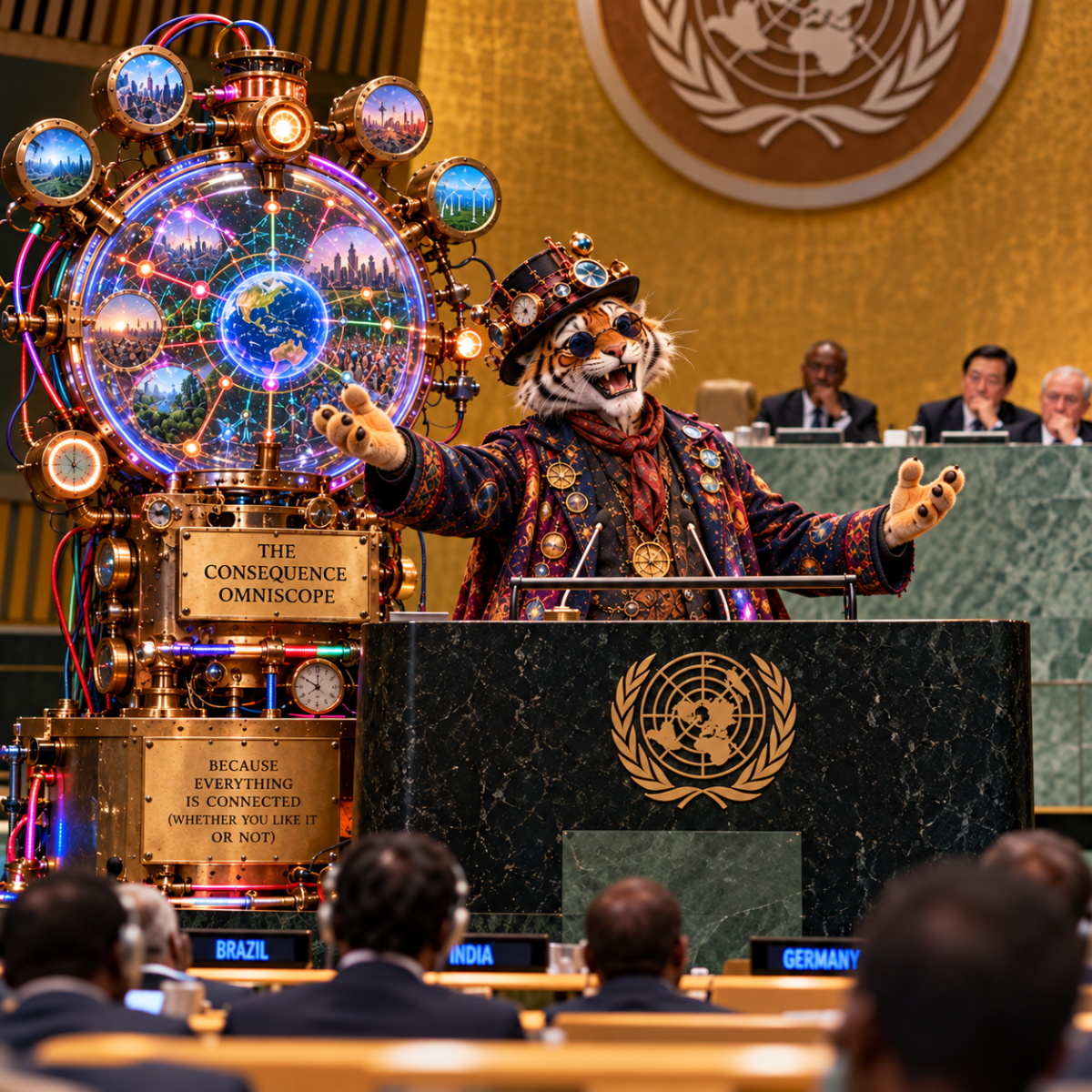
When humanity finally runs out of idiots to put in charge, it turns to Captain Fractal. Armed with decades of systems thinking, a ridiculous hat and a dangerous understanding of consequences, he sets about un-fucking civilisation.

Europe’s unrest is sustained by a self-reproducing system of conflict in which opposing positions become mutually sustaining and unresolved grievances become politically and commercially valuable.
Climate change is not a problem inside a stable planetary system. This text indicates how it is reorganising the relations through which planetary stability itself is reproduced.

A civilisation builds systems to solve its problems, then discovers that the systems have become the problems, while its dependence upon them has made their continuity deeply problematic.
Ideology is what happens when a way of seeing the world becomes part of the world itself, shaping not only what we believe, but what becomes easier to believe next.
The probable is a proper subset of the possible. Old habits die hard because viable communication preferentially reproduces patterns that make themselves more likely to recur.

What persists is neither order nor entropy, but the organised difference through which each continually transforms the conditions of the other.
Life is not astonishing simply because it exists. It is astonishing because, against every available opportunity to fall apart, it keeps holding together and this resilience is the kernel core of its persistence.

The only (or at least most) comprehensive way to account for emergent behaviour is to grant some ontic reality to the abstract relational patterns, symmetries, and phase dynamics that bind and sustain it. A collection of things is, in other words, also a thing. That is not especially surprising at one intuitive level, but it […]
The unconscious is not a hidden chamber beneath awareness, nor a secondary mind running in parallel. It is the emergent interior of dynamical, adaptive, relational complexity itself. It is what complex systems feel like from the inside. Any system capable of learning, anticipation, coordination, and self-regulation must generate internal structure that cannot be fully present […]

The notion (articulated in the video) that the homeostatic process by which quasicriticality is maintained in the brain may have an essentially cybernetic explanation. In Jeff Hawkins’ “A Thousand Brains” he references neurophysiologist Vernon Mountcastle’s belief in the existence of an underlying (as unifying) organisational principle in the brain. I wouldn’t be at all surprised […]

The cognitive potential of any system is not so much a product of its informational architecture as it is a function of the dissipative dynamics that sustain it. This is where the black box of intelligence comes in – it is not so much a lack in our understanding of how the brain works, but […]
Have a WordPress.com account? Log in now.

