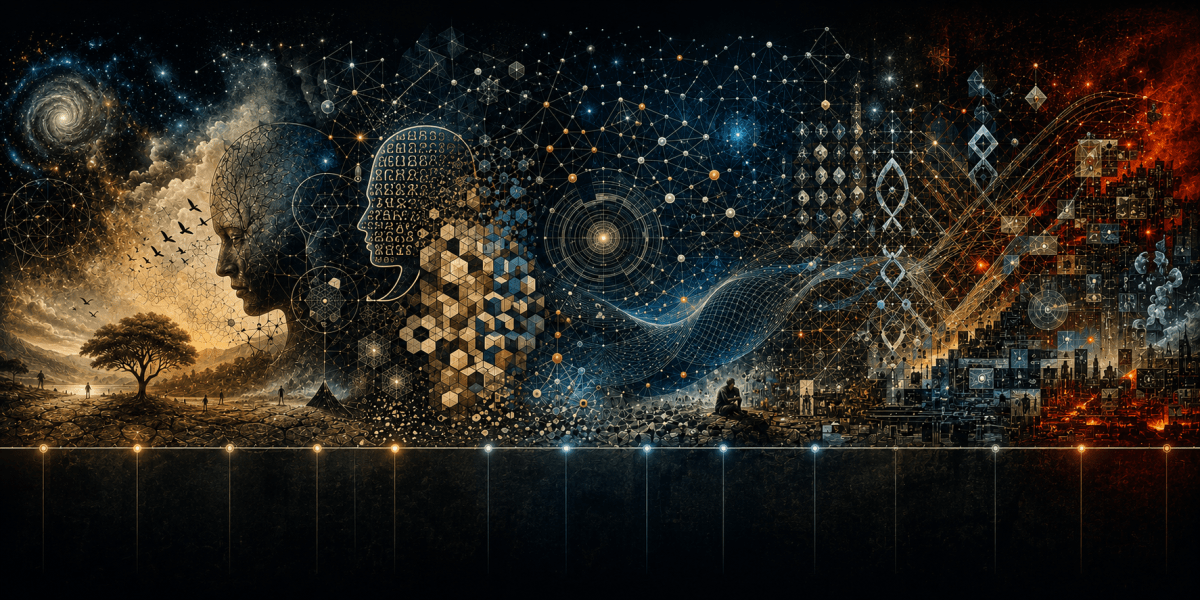
These essays circle a problem I have been working on for a long time: how organised patterns persist through change.
The question begins simply enough, with meaning, language, identity and time, but it does not stay there. The same problem appears in communication, politics, institutions, technology, conflict and civilisation. These are not separate worlds. They are different expressions of systems continually making, maintaining and transforming relations.
I am necessarily inside the problem I am describing. So are you. Language, institutions, technologies and cultures are not things we stand outside and observe from a safe distance. We participate in them while attempting to understand them, using distinctions and languages that are themselves products of the systems under examination.
The essays are written for general readers and draw upon several decades of engagement with systems theory, cybernetics, philosophy, complexity and communication. They can be read independently. Taken together, they describe a larger and still developing theoretical project.
Selected Essays
1. Human Systems
https://daedeluskite.com/2025/12/01/human-systems/
Human behaviour gathers around centres that never quite appear. Coherence emerges not from perfect fit but through the differences, tensions and unresolved relations that prevent systems from collapsing into certainty.
2. The Strangeness of Life
https://daedeluskite.com/2021/10/09/the-strangeness-of-life-2/
Human life is so deeply embedded in its own cultural, symbolic and existential context that its strangeness becomes difficult to see. The essay moves from cosmic scale to identity, otherness, culture and communication, asking what becomes visible when the familiar is treated as genuinely peculiar.
3. Language lies to us, through us
https://daedeluskite.com/2020/12/29/language-lies-to-us-through-us/
Language is not merely something we possess and manipulate. Its structures reproduce through human communication, shaping the thoughts and distinctions through which we attempt to understand both language and ourselves.
4. Transmission: Unwriting I
https://daedeluskite.com/2022/01/24/transmission-unwriting-i/
Language persists through continual transmission and transformation. The attempt to preserve meaning therefore depends upon the same processes of alteration, dissolution and reconstruction that make communication possible in the first place.
5. Empty
https://daedeluskite.com/2023/10/16/empty/
Meaning does not reside independently within isolated symbols or nodes. It is distributed across relations, contexts and communicative systems whose connections make locally identifiable meaning possible.
6. how language shapes the reality we think we inhabit
https://daedeluskite.com/2026/01/14/living-inside-language/
We do not simply use language to describe a pre-divided world. Language helps establish the distinctions through which the world becomes intelligible to us, while remaining part of the reality it attempts to describe.
7. Theory of Language and Communication
https://daedeluskite.com/2026/01/25/theory-of-language-and-communication/
A process-based account of language and communication in which meaning, identity, legitimacy and truth emerge through repetition, coupling, feedback and temporal organisation rather than existing as static foundations.
8. The Necessary Distance: Why Perfect Synchrony Destroys Identity
https://daedeluskite.com/2025/09/30/the-necessary-distance-why-perfect-synchrony-destroys-identity/
Coherence requires similarity, but identity requires difference. Perfect synchronisation destroys the very distinctions through which individuals and systems remain identifiable at all.
9. The Architecture of Absence
https://daedeluskite.com/2026/05/25/the-architecture-of-absence/
What appears stable is usually a moving balance of dependencies. Difference, distance, ambiguity and incompletion are not defects in organised systems but part of the relational structure through which identity, resilience and continuity remain possible.
10. continuity precedes truth
https://daedeluskite.com/2026/06/10/continuity-precedes-truth-2/
Information and disinformation emerge from the same deeper communicative processes. Truth and falsehood remain important distinctions, but both arise downstream from systems that first organise uncertainty into sufficiently coherent and persistent meaning.
11. reality
https://daedeluskite.com/2026/06/21/reality-2/
Reality is approached not as a collection of independently existing things, but through relational structures whose temporary coherence produces the things, identities and forms we experience as persistent.
12. logical orbit: organised persistence as relational invariant
https://daedeluskite.com/2026/07/14/invariant-transformation/
A system persists not by preserving what it is, but by continually reorganising the field of what it can become. Logical orbit names the recurrent organisation through which recognisable continuity survives continual material and informational change.
13. Symbolic Traffic
https://daedeluskite.com/2025/12/29/symbolic-traffic/
Language propagates through human activity while complex adaptive systems reshape their environments toward their own continuation. What persists is neither system nor environment alone, but their continuing relational entanglement.
14. pathological homeostasis
https://daedeluskite.com/2026/07/05/geopolitical-escalation-2/
Systems created to overcome disturbances can become organised around maintaining them. Conflict, crisis and dysfunction become remarkably persistent when the surrounding system learns to reproduce itself through their continuation.
15. why administrative organisational systems fail
https://daedeluskite.com/2026/05/28/why-administrative-organisational-systems-fail-2/
Administrative systems begin to fail when their representations of reality become more important to their operation than the reality they were created to administer.
16. technology’s hidden dependency on conflict
https://daedeluskite.com/2026/07/07/tesseract-technology/
Technology and conflict do not simply cause one another. They participate in a recursive relationship in which competition, uncertainty and technological development continually reshape the conditions for one another’s persistence.
about the author
Graeme is an independent systems theorist and writer working across cybernetics, complex systems, philosophy, communication, technology and political thought. He completed a Master of Applied Cybernetics at the Australian National University in 2022.
His work returns repeatedly to a deceptively simple question: if everything changes, what does it actually mean for anything to persist?
Daedelus Kite is where he has been trying to find out.
 Daedelus Kite