Categories
cybernetics

The Structural Risk of Technological Acceleration: Why Delay, Feedback, and Time Still Govern Complex Systems

Yesterday, sitting with a coffee, I fell into conversation with a group of photography students. It occurred to me that photography, particularly digital photography, is a curious artefact. It feels modern, yet in an important sense it belongs to a slower world, a medium that still obliges attention to pause between perception and interpretation. Consider […]

Categories
cybernetics

Time, Delay and Systems Theory: Vortex Dynamics

Dynamical structure reveals itself through the propagation of signals. We do not encounter systems first as finished objects and only later as processes; we encounter them through motion, response, transmission, lag, and constraint. Signals move through fields and never arrive instantly. Delay is therefore not an imperfection added to an otherwise complete world. It is […]

Categories
cybernetics

Conflict: Metaphysics of Non-Closure

Conflict and competitive adversarialism are not necessarily moral failures or aberrations. They are contingent, historically acquired, culturally entrained mechanisms by which complex cognitive, cultural, and communicative systems reliably differentiate, learn, and reproduce themselves over time. These mechanisms arise because complexity does not form around completeness, nor does it arise from closure, certainty, or final resolution. […]

Categories
cybernetics

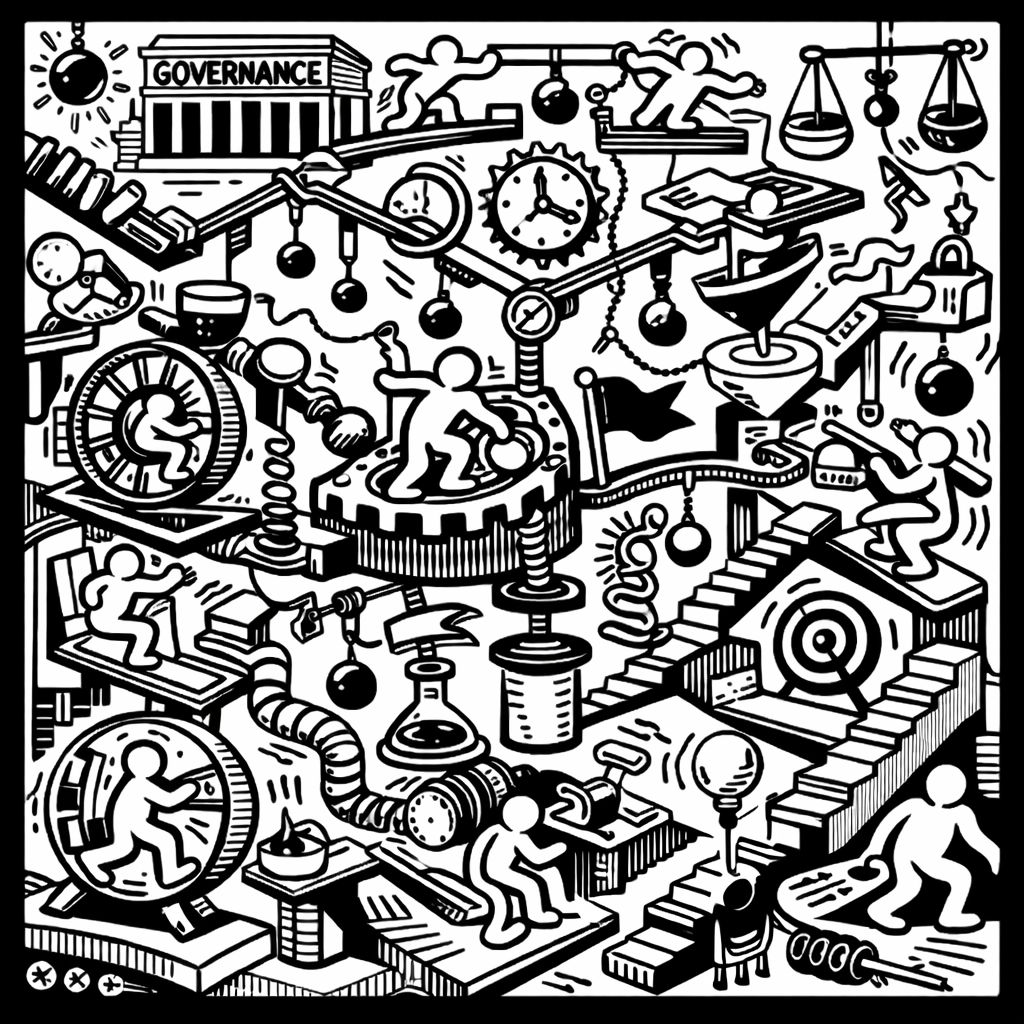
Governance as Harmonic Coordination

Governance can be understood as the management of phase relations within an ensemble, not the enforcement of uniform behaviour. In any governed system—social, institutional, technical, or ecological—coherence does not arise from fixing positions or eliminating difference. It arises from partial synchronisation: agents align enough to act collectively while remaining out of phase enough to retain […]