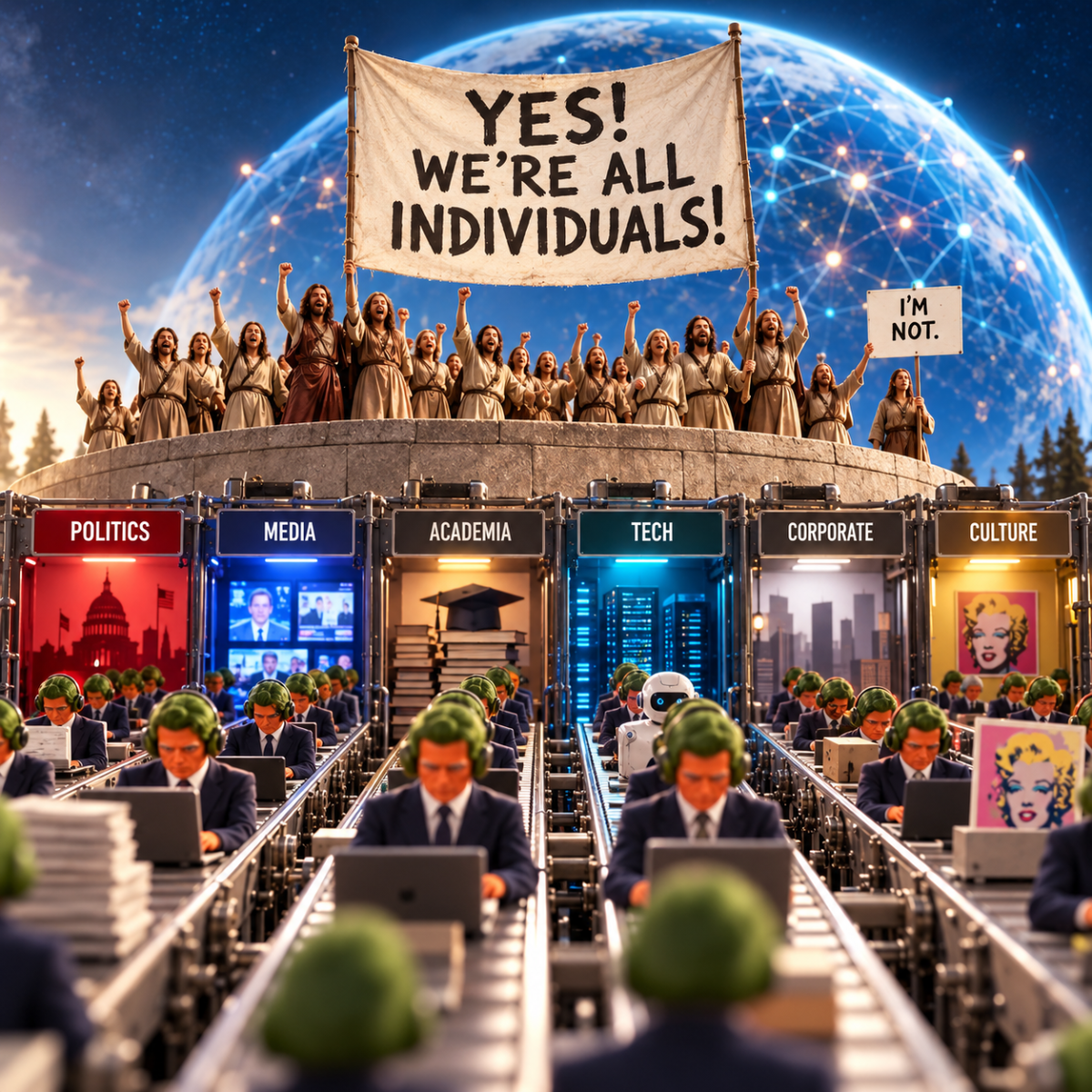
One of the stranger things about watching global communication is discovering how remarkably similar everybody is in their determination to be different. Every institution, discipline, political movement, intellectual community and technological enterprise has its own vocabulary, its own values, its own authorities and its own carefully maintained account of what makes it distinctive. Each operates as a little fiefdom, reproducing the conditions under which its particular understanding of the world continues to make sense. Different costumes, different slogans, same little Oompa Loompa machinery.
The interesting thing is not that these communities disagree. It is that they organise their disagreements in much the same way. They establish boundaries, recognise insiders, reward familiar contributions and develop increasingly sophisticated reasons for disregarding whatever does not fit. Their identities depend upon differences that they must continually reproduce. The more successfully they distinguish themselves from one another, the more clearly their common behaviour becomes apparent.
This is a curious consequence of looking at communication across the whole rather than from within any particular community. What appears locally as intellectual independence becomes, across the ensemble, a recurring pattern of conformity. Everybody is busy producing their own version of difference, using remarkably similar processes of selection, repetition and exclusion. Nobody needs to coordinate this. The larger pattern emerges from the accumulated activity of communities pursuing their own interests.
Technology has made this considerably more interesting, and not necessarily in a good way. Global communication allows these processes to operate at extraordinary speed and scale. Algorithms reward recognisable patterns, institutions reward established expertise, and audiences reward familiar expressions of their existing beliefs. Even criticism becomes part of the machinery, provided it arrives in a form the machinery already knows how to recognise. The system does not need to suppress unfamiliar ideas. It can simply fail to reproduce them.
There is a deeper irony here. The communities that regard themselves as most intellectually independent are not necessarily any less susceptible to these dynamics. Independence itself becomes an identity to be maintained, defended and rewarded. The vocabulary changes, the boundaries move, and the same pattern reappears. This is not an accusation of hypocrisy. It is a feature of how collective identities persist through communication, whether their participants recognise it or not.
And here I am, attempting to describe the pattern from within the same global machinery. There is no privileged position outside it, no magical vocabulary immune to repetition, and no guarantee that recognising the process prevents participation in it. Even this observation must compete for attention within systems that largely determine what deserves attention in the first place. Which brings us back to Monty Python’s Life of Brian, and that wonderful moment when the crowd enthusiastically declares, in perfect unison, “Yes! We’re all individuals!”
One solitary voice objects.
“I’m not.”
Naturally, nobody listens.

