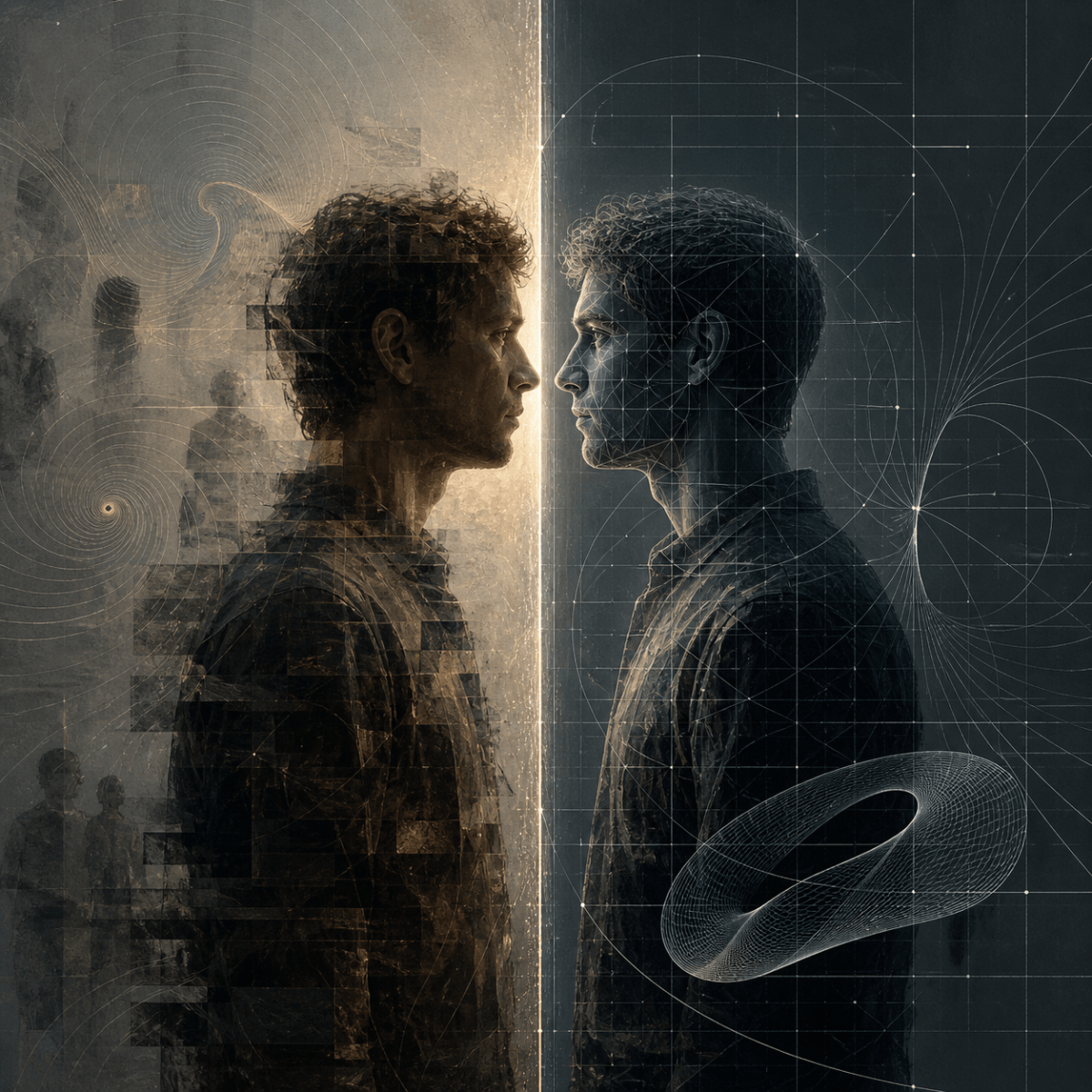
People are frightened of other people because another person is not merely a body in the room but a source of interpretation. They can hurt us, reject us, laugh at us, unsettle us, misunderstand us with great confidence, remember our weakest moments, turn an error into a social fact, or look at us in a way that makes the body suddenly aware of itself as an object among objects. A storm may destroy a house, but it does not humiliate the owner. A machine may fail, but it does not look disappointed. Other people can make meaning out of us. They do not only see us; they read us, then return us to ourselves through whatever grim little filing cabinet of inherited categories they carry behind their eyes.
The deeper danger is not difference itself, but the gap that difference reveals. The self is not a sealed object hidden inside the body, a little monarch behind the eyes, issuing orders from some damp neurological throne. It is a pattern that holds: body, memory, language, wound, habit, relation, recognition, time. A flame is not hidden inside the fire; it is the fire holding a form for a while. A vortex is not merely water spinning around absence; it is a system falling into a low-energy geometry, a patterned settlement where boundary conditions disclose the attractor. A melody is not hidden inside the notes; it is the relation between them, sustained long enough to be recognised. The self belongs to that strange family of realities: not less real for being conditional, but real because its conditions briefly hold.
In Lacan’s mirror stage, the infant identifies with a coherent external image of the body as a whole that lived experience can never fully inhabit from within; the “I” begins as a rupture, a borrowed unity, an abstract geometry of selfhood into which the living body falls. The story matters beyond childhood because individuation keeps following this pattern: person, family, institution, nation, culture, and historical moment all take shape by falling into prior geometries of recognition. Family gives one mirror, work another; nation, gender, class, beauty, illness, money, usefulness, failure, desire, diagnosis, status, and morality give others. Some mirrors flatter, some wound, some merely compress us into whatever category the system can process before lunch. None are neutral. We are not merely seen by others; we are partly made through being seen. So fear of the other folds back into fear of the self: the suspicion that “I” and “you” are not primary substances, but stabilised differences inside experience.
This is not emptiness as negation. It is emptiness as structure. The self is what absence does when organised; the other is what absence does elsewhere. A blank page is not the enemy of writing. Silence is not the enemy of music. Zero is not one more object in the pile, yet without it the architecture of number changes. Nothingness is not merely what is missing. It is what allows form to occur. Some version of the disturbance we call fear may even be necessary, because the body reads boundary-change before thought can interpret it. A self that felt no instability at its edges would not be peaceful; it would be unable to distinguish contact from collapse, recognition from invasion, openness from dissolution.
The tragedy begins when this necessary boundary-sense hardens into suspicion, and suspicion acquires tools. Categories, documents, markets, passwords, profiles, risk scores, customer numbers, behavioural analytics: the whole bright carnival of managed uncertainty. Society stabilises fear by sorting people; technology accelerates the sorting; the person becomes legible by becoming smaller. The old mirror becomes a screen, the screen becomes a file, the file becomes a score, the score becomes a decision, and the decision becomes the person. That is the sick state, in both senses: not always cruel, not always dramatic, often polite, credentialed, efficient, and well-lit. A system can erase people without hatred. It only has to prefer its model of them.
The escape is not to abolish fear, dissolve boundaries, or melt into some warm pudding of universal compassion. Difference matters. Bodies matter. Harm matters. Sometimes the correct answer is distance, refusal, law, or a locked door. But the boundary is necessary, not ultimate. A healthy social field preserves enough uncertainty for recognition to remain alive; it allows delay, ambiguity, appeal, silence, revision, and the possibility that the system is wrong. Perfect legibility is not health. It is the administrative form of death. Life requires the gap. Being requires discontinuity. Recognition requires risk. The other is terrifying because they are not only other; the self is terrifying because it is not only self. Between them is the field where fear becomes recognition, recognition becomes language, language becomes order, and order, unless watched, becomes a cage congratulating itself on the quality of its hinges.
Categories
why fear of others is really fear of an unstable self
Fear of others is not finally fear of difference, but fear of the gap through which the self discovers it was never solid, never alone, and never entirely its own.