Desire and fear appear to pull us in opposite directions, but both persist through the distance they seek to overcome.

Desire and fear appear to pull us in opposite directions, but both persist through the distance they seek to overcome.

Absence is not a flaw in the structure. Absence is the engine.
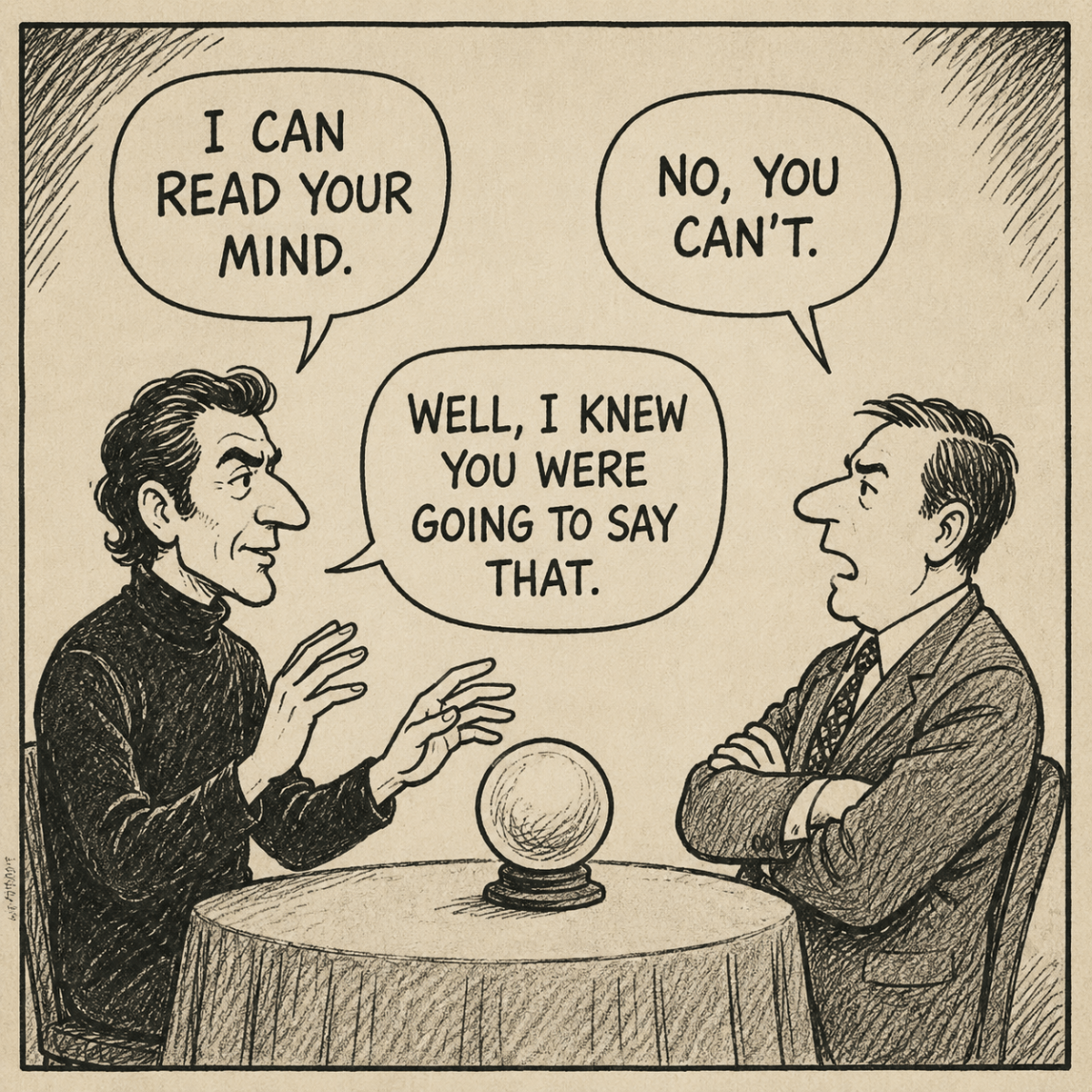
The self depends on a membrane of belief separating “me” from the world, though almost everything constructing that “me” comes from elsewhere.

Fear of others is not finally fear of difference, but fear of the gap through which the self discovers it was never solid, never alone, and never entirely its own.
The self never settles because the world never settles. Your body changes. Neural chemistry fluctuates. Memory edits itself. Relationships move. Context rearranges. Words drift. Culture turns. New facts arrive, old certainties decay, and the feedback never stops. So the self is not rewritten because it is faulty, but because it is embedded in conditions that […]
The self is commonly understood as something one has: a centre of experience, a point of view, a continuous “me” that persists through time. Psychological models tend to formalise this intuition by treating the self as a representational structure—narrative continuity, minimal experiential core, or predictive model—through which coherence can be maintained. This move is not […]

The self orients itself toward abstractions it can never fully coincide with, and it is precisely this gap—the not-quite-matching—that constitutes the self. The difference is not a flaw but the inflation of the relational space within which intelligibility arises. The self is not a closed entity but the pattern of deferrals and resonances that language […]

Individuation isn’t the slow refinement of a solid self; it’s the gradual recognition that the self was never there in the first place. What loops back through time is not an enduring “I,” but a process — the interplay of perception, memory, and change, tracing shapes in a field that doesn’t belong to any of […]
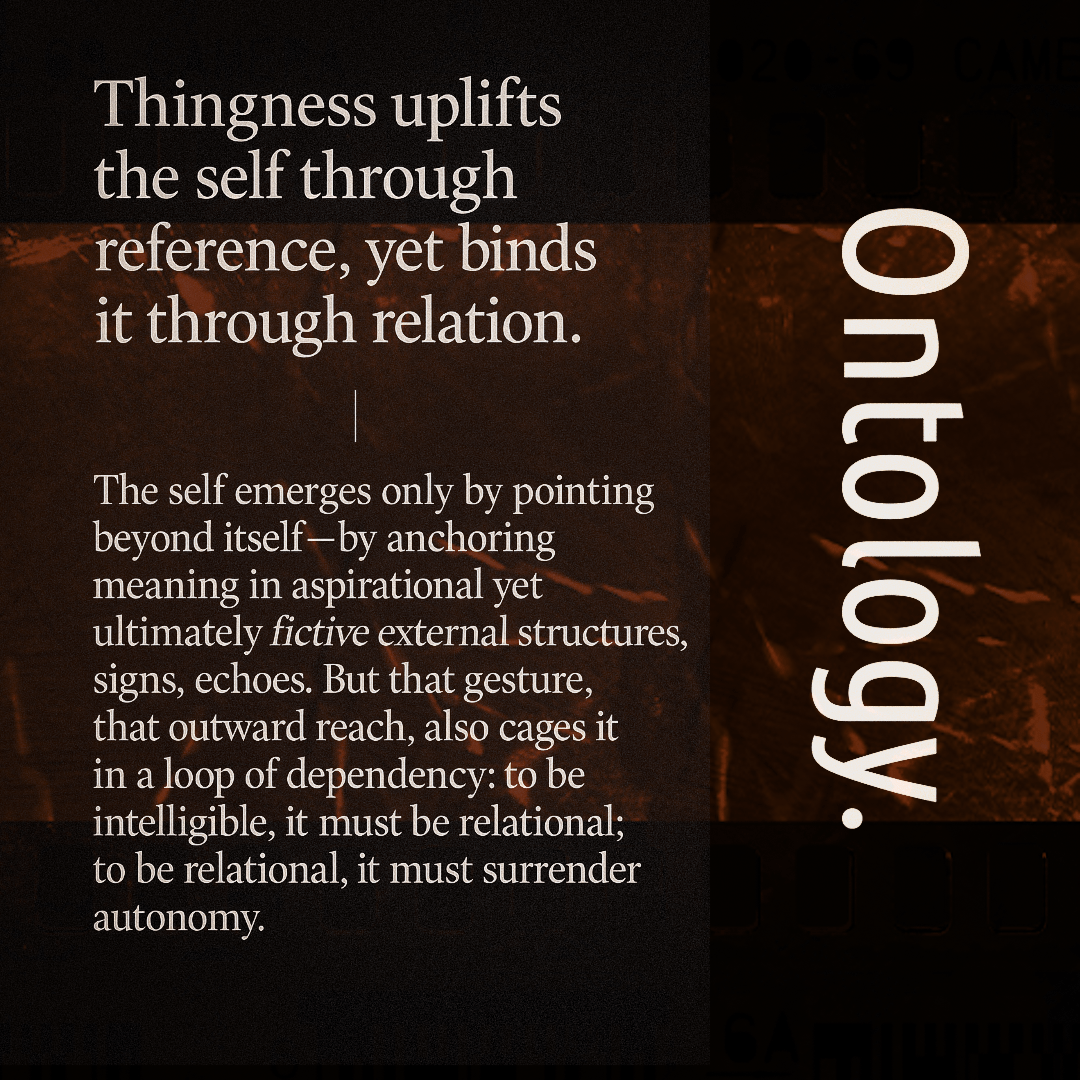
Thingness uplifts the self through reference, yet binds it through relation. The self emerges only by pointing beyond itself—by anchoring meaning in aspirational yet ultimately fictive external structures, signs, echoes. But that gesture, that outward reach, also cages it in a loop of dependency: to be intelligible, it must be relational; to be relational, it […]

One’s relationship with others feels, to me, to be a subset of one’s relationship with one’s self; and vice versa. Regardless that that’s one hell of a lot of ones, Kierkegaard made the point that this introspective opening up of structure precisely is the self, the mind, our experience and the world. I only saw […]

Identity is not a fixed entity but represents a shifting construct and constellation of relationally-networked facts, orbiting in some sense around an inherent emptiness—an enigmatic absence that defines rather than diminishes. In this space, identity and meaning emerge as relational, shaped by the dynamic interplay between self and other. Language, too, becomes part of this […]

A thing being as equally and oppositely defined by that which it is not as much as by what it provably is (or consensually appears to be), the absence of its opposite is the simultaneous presence of its psychological, cultural and technologically-mediated self. Facilitated by conveniences of Gestalt illusion, familiar enough to student artists but […]
Have a WordPress.com account? Log in now.

