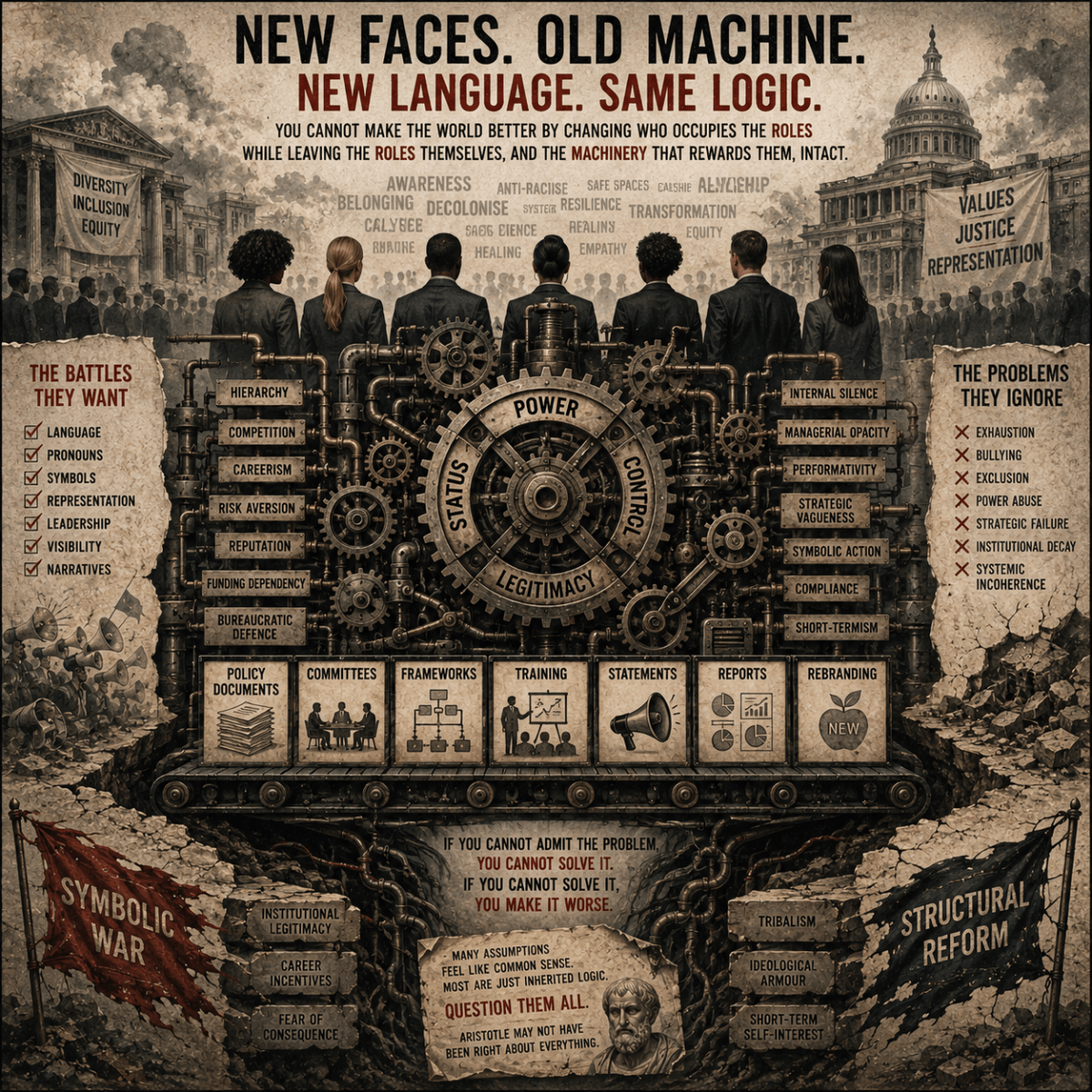
The modern institutional obsession with representation often mistakes symbolic correction for structural transformation. Many academic and bureaucratic environments now direct enormous moral energy toward identity, visibility, historical injustice, and exclusion. Much of that concern is necessary. Racism, misogyny, social exclusion, and historical violence are real forces with real consequences. But a strategic failure appears when an institution treats diversified leadership as though it were equivalent to redesigning the systems those leaders inherit. You cannot make the world better by changing who occupies the roles while leaving the roles themselves, and the machinery that rewards them, intact.
The deeper problem is that many reform projects quietly preserve the competitive logic they claim to oppose. The story becomes that better people should occupy positions of authority: more ethical people, more aware people, more marginalised people, more women, more culturally sensitive people. There is value in broader participation, but this still leaves the central architecture intact. The institution remains hierarchical, status-driven, career-protective, bureaucratically defensive, and fluent in the old art of making power look like responsibility. The pilot changes. The cockpit remains bolted to the same burning aircraft.
Many contemporary institutions now possess extraordinarily sophisticated vocabularies for discussing systems, ethics, complexity, communication, care, and social responsibility, yet often appear far less comfortable applying the same degree of structural scrutiny to themselves. This is not unusual. Universities, governments, corporations, media organisations, and bureaucracies everywhere struggle to publicly confront the contradictions embedded within their own operational behaviour because doing so threatens legitimacy, funding, reputation, internal cohesion, and career stability simultaneously.
This is the larger strategic error. Institutions frequently become unable to address problems precisely because they cannot openly acknowledge the extent of those problems without destabilising themselves. The result is a culture of partial recognition: enough awareness to produce symbolic action, carefully managed language, committees, panels, frameworks, and ethical positioning, but not enough willingness to confront the deeper operational machinery generating the dysfunction in the first place. Problems therefore persist beneath the surface while the institution increasingly manages their appearance rather than their cause.
Culture-war politics make this easier rather than harder. Institutions can sponsor highly visible struggles over representation, language, identity, and leadership because these conflicts remain administratively manageable. They produce measurable signals of ethical movement and public responsiveness. Meanwhile, the deeper patterns of exhaustion, bureaucratic self-protection, managerial opacity, strategic incoherence, internal silencing, dependency, and career-oriented caution continue operating underneath. In this sense, symbolic conflict can sometimes function less as transformation than as displacement: the emotional energy of systemic frustration redirected into narratives that the institution can safely absorb.
The same pattern appears far beyond universities. Governments, corporations, media systems, and political movements across the world increasingly struggle to admit the scale of the problems they cannot adequately solve. Instead, systems often become trapped in cycles of symbolic substitution: replacing leaders, slogans, values statements, strategic plans, or public narratives while leaving the underlying organisational logic largely untouched. This is why many societies now feel simultaneously hyper-verbal and strategically paralysed. The language of transformation expands while the operational architecture generating instability remains remarkably persistent.
The deeper challenge therefore runs beyond representation alone and into the assumptions through which institutions define reality itself. Questions of value, legitimacy, hierarchy, identity, morality, and control are not neutral technical categories. They emerge from inherited frameworks of thought that many institutions rarely examine at foundational level because those frameworks stabilise the institution’s sense of itself. Yet if the underlying logic remains competitive, status-oriented, bureaucratically self-protective, and unable to tolerate genuine structural self-analysis, reform risks becoming another method through which systems reproduce their own conditions of failure. That is not merely an institutional problem. It is increasingly the defining organisational pathology of modern civilisation itself.
 Daedelus Kite