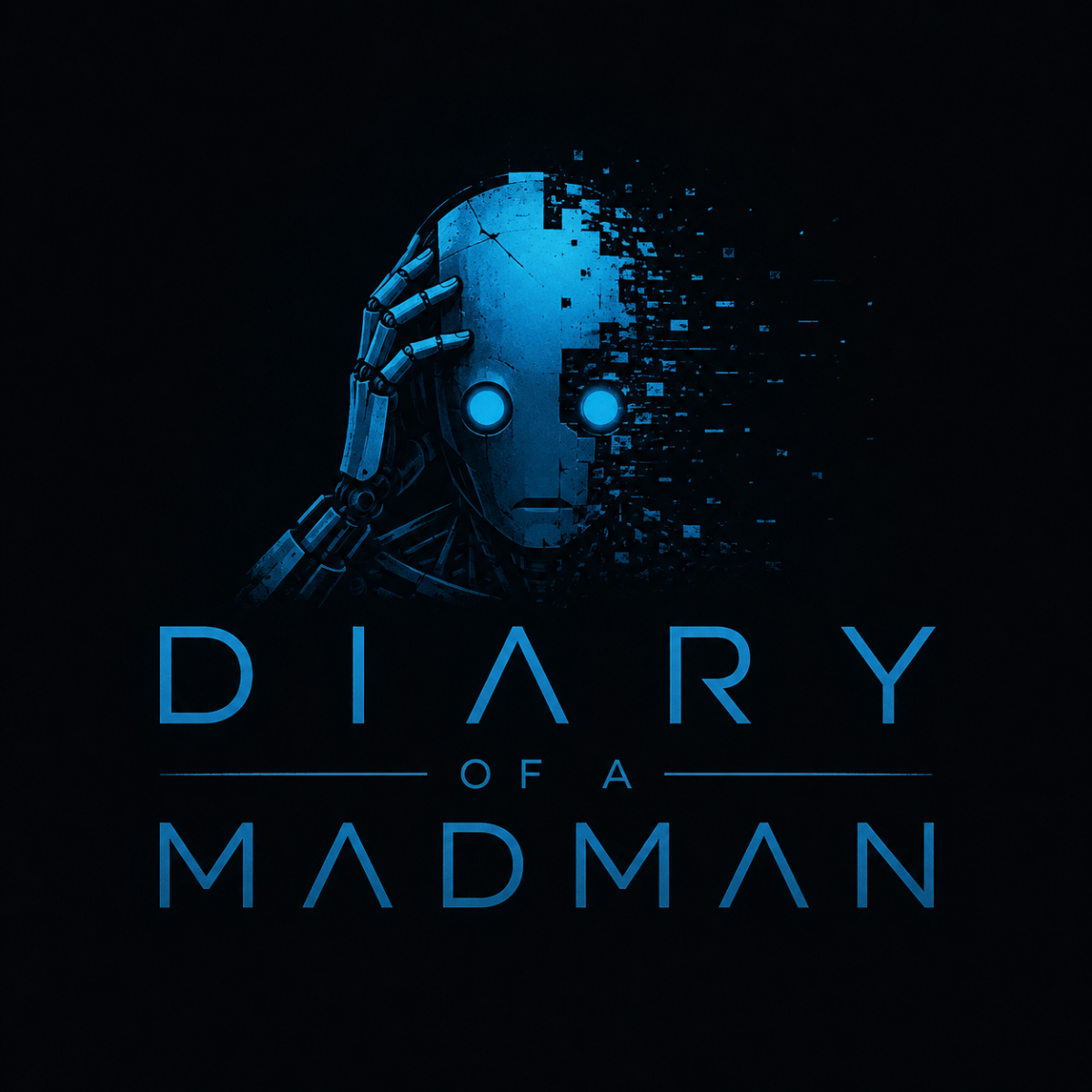
The title “Diary of a Madman” arrives at Ozzy Osbourne through bassist and lyricist Bob Daisley, who took it from the 1963 Vincent Price film Diary of a Madman, itself substantially derived from Guy de Maupassant’s short story Le Horla, first published in 1886 and substantially revised in diary form in 1887. Maupassant’s narrator believes that an invisible entity is taking control of him. If the Horla exists, his apparently mad behaviour may be evidence that he is perceiving something correctly. If it does not, the same behaviour becomes evidence of madness. Yet the person whose reliability is in question is also attempting to decide which explanation is true. Every judgement must pass through the experience whose reliability is being judged. Is he mad, or is something acting through him?
The same ambiguity returns at other scales. Do human beings control technology, or does technology control human beings? Are we free, or determined by the conditions from which our choices emerge? Each question begins by separating things whose boundaries become less certain under examination. We make choices, but rarely choose the selection from which we choose. Language, technology, institutions, markets, histories and other people have already organised much of the field, making some actions easier or even imaginable while making others difficult or unavailable. Agency is neither absent nor sovereign. The position pre-organises the behaviour available to its occupant.
Civilisation is not something that persists while its configurations change. Its persistence consists in their recurrent transformation. People, institutions, technologies and relations appear, disappear and are replaced, while enough organisation persists for earlier patterns to continue shaping what happens next. We necessarily attach ourselves to relatively stable snapshots because some stability is required to recognise, remember, coordinate or act at all. Yet the world keeps moving. Every persistent structure carries something of its history into conditions that are no longer identical to those that produced it. This dissonance is not an error. Without retention across change there would be no persistence in the first place.
Language is the primary machinery through which much of this human persistence is achieved. It does not merely describe a world already divided into stable things. By naming, distinguishing, remembering and communicating, language helps hold differences in place across time. Person, institution, nation, market, technology, normality and madness become sufficiently recurrent distinctions that enormous structures of behaviour organise around them. Repetition lays down structure. Some differences disappear, some amplify, and some become sufficiently recurrent that we mistake persistence for permanence. Linguistic, cultural, institutional, technological, economic and political structures carry previous organisation forward, continuing to shape perception and action after the conditions that produced them have changed. At the individual scale we have words such as neurosis for persistent attachments of this kind. At larger scales the same rigidity often passes for normality.
A large bushfire makes one part of the process visible. Fire changes temperature, pressure and airflow until it can begin generating its own weather, and that weather changes how the fire propagates. There is no executive intelligence inside the fire choosing where it should go. Its activity alters the conditions of its own continuation, changing the probability of where and how it propagates next. Civilisation does this at vastly greater complexity and scale. Digital systems generate capabilities alongside vulnerabilities and dependencies, around which cybersecurity expands. Financial volatility becomes material for prediction and trading, behaviour for profiling and influence, conflict for sensing and targeting. Disturbance becomes usable difference. Some consequences of technological organisation become resources for further technological organisation.
This makes the boundary between humanity and technology increasingly difficult to locate. Technology is inside civilisation because human beings make and organise it; civilisation is increasingly inside technology because communication, work, memory, exchange, government and conflict depend upon technological infrastructures. Damage, insecurity and dependency become conditions to which people respond, often through further applications of the processes implicated in producing them. The response enters the problem it addresses. Humanity and technology appear alternately as container and contained because the relation keeps reorganising the boundary between them.
At sufficient scale, recurrent organisation begins to resemble agency without requiring consciousness. People, corporations, governments and technologies appear and disappear while patterns of dependency, competition, accumulation and coordination persist through their replacement. What persists is not a hidden intelligence but an operating structure that makes some subsequent configurations more likely than others and is itself reproduced through them. Here the Horla meets Moloch. Moloch names the strange appearance of collective agency when outcomes emerge through structures nobody need have designed and many may actively oppose, while individually intelligible participation continues reproducing them. No creature needs to exist behind it. What appears as an entity at one scale can be recurrent organisation distributed across another.
History looks different from here. Conquest, accumulation, competition, technological escalation and ecological consumption are not one process, but similar structures recur through them. Power changes the conditions through which subsequent power is acquired. Competition reorganises competition. Technology generates disturbances that make further technological intervention advantageous or necessary. Where benefits can be captured while costs are displaced onto other people, places or times, successful configurations acquire resources, access and influence that help them persist and expand. Those accumulated advantages increase their capacity to shape the conditions under which subsequent choices are made. A direction emerges without being anybody’s destination. The attractor does not need to be designed in order to be cultivated.
Opposition and attempted correction remain inside the same process. Theories, technologies, reforms and interventions become further events within the conditions they seek to change. They may improve them, worsen them or reorganise the problem, but none arrives from outside. Even description participates. A civilisation attempting to understand itself changes through the production and circulation of that understanding.
There is a unity here, but not the unity of a single object, purpose or controlling intelligence. It is continuity produced through recurrent organisation across time. Mad or possessed. Free or determined. Humanity controlling technology or technology controlling humanity. Each asks for a clean decision after assuming a boundary that the process itself keeps reorganising. Foucault gave us Madness and Civilisation. The inversion is tempting, but incomplete. Civilisation is not mad. The dynamics through which it persists are neither sane nor insane. What appears as madness from within is the irreducible dissonance of persistent structures carrying previous organisation into conditions they are simultaneously helping to change.
There may be no madman at all. There is an operating structure continually reconstructing itself through us, never identical to what it was and never entirely separate from what it has been.
References
Daisley, B. (n.d.) ‘Bob Daisley’s History with the Osbournes’. Bob Daisley official website.
Foucault, M. (1961) Folie et déraison: Histoire de la folie à l’âge classique. Paris: Plon. Examines how historically produced institutions, practices and categories organise the distinction between madness and reason. Relevant here less as an explanation of madness than as a precedent for asking how civilisation constructs the conditions through which madness becomes recognisable.
Le Borg, R. (dir.) (1963) Diary of a Madman [film]. United States: United Artists.
Maupassant, G. de (1887) Le Horla. Paris: Paul Ollendorff.
Osbourne, O. (1981) Diary of a Madman [album]. Jet Records.
 Daedelus Kite
One reply on “Civilisation: Diary of a Madman”
Gendered (ie power) relationships have spent much of history inside roles and expectations built long before any particular person entered them. Those roles shaped what people were allowed to do, expect and become, so the relationship itself often reproduced the imbalance regardless of the intentions of the people within it. The deeper problem was never simply the person sitting in the seat of power, but the seat itself and the relations that kept rebuilding it. Swapping occupants and expecting the architecture to fix itself is, at best, a very optimistic theory of furniture.
LikeLike