Categories
Peace

Peace as Freedom from Self

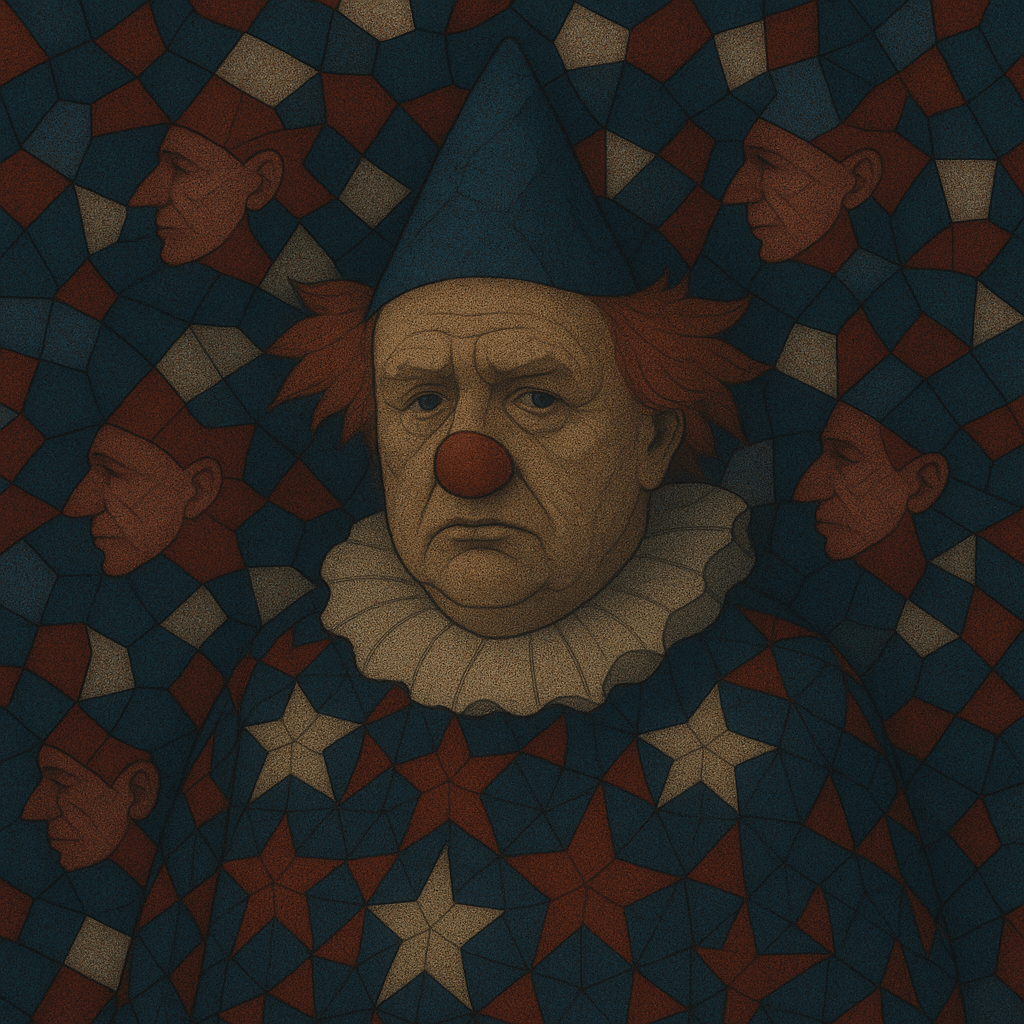
Peace begins where the self dissolves, not as annihilation but as return. The mind’s reflex to grasp at identity falters, and what remains is the stillness that underlies all becoming. In the portrait, serenity is not performed—it emanates from absence. Light and shadow no longer compete; they coexist, sustained by the same field. The face […]

Categories
cybernetics

Strategic Immaturity

Strategic Immaturity: The belief that gaining control—whether by overthrowing, reforming, or mimicking existing structures—will alter the logic of power itself. In practice, such acts merely replicate and stabilize the very asymmetries they claim to end, reinforcing hierarchy under a new name. Power, once seized, becomes its own justification, not its solution.

Categories
cybernetics

Language

Abstract: This essay explores how civilisation’s systems—political, economic, and technological—emerge from a mistaken belief that language contains the world, when in truth the world contains our descriptions. The error of equating description with reality is not an isolated flaw but endemic to the distributed, manifold-like topology of semantics itself: uncertainty is not peripheral but woven […]

Categories
Philosophy

The Logic that Lives

Life, in its most abstract sense, is a contradiction that refuses to resolve. It persists as a dynamic equilibrium between forces that can never perfectly align. Every organism, idea, or particle exists not by finding rest but by orbiting imbalance—by sustaining tension as continuity. The living field is not static; it is recursive, a looping […]

Categories
Philosophy

Living Energy Fields

Peter Mitchell was a British biochemist who transformed biology by introducing the chemiosmotic theory — the idea that cells generate energy through electrochemical gradients across membranes, overturning the then-dominant mechanistic view of metabolism. “I cannot consider the organism without its environment… from a formal point of view the two may be regarded as equivalent phases […]

Categories
Philosophy

Dracula: The Dark Compass

It was a poor family’s living room, perhaps middle-aged in its furnishings—brown vinyl couch, lace curtains, the dull hum of the refrigerator cutting through the silence. Count Dracula stood in the doorway, narrating the long drift of history to the wife of the man he had just turned, consumed as undead. “I knew the future […]

Categories
cybernetics

General Intelligence

Imagine F and G as two interdependent operations—each defining the other through difference. F acts as a generator: it constructs hypotheses, projections, or internal states. G acts as a comparator: it evaluates, reflects, and reintroduces the outcomes of F back into the system. The diagram’s symmetry, where F = − G, indicates an inversion rather […]

Categories
Philosophy

The First Wish

If a genie appeared and offered three wishes, the first would be the only one worth making. Infinite wishes betray the premise—they hollow out the point. The trick isn’t to ask for more, it’s to ask well. So I would wish for the ability to write as though casting spells upon the world. To breathe […]

Categories
cybernetics

Bad Managers

Everyone in the modern enterprise claims to want innovation, but few will risk what it requires. The fear of disturbance—of deviating from the delicate choreography of compliance and plausible deniability—has become the governing logic of management. Systems now reward those who maintain appearances, not those who learn. The result is a recursive theatre of progress: […]

Categories
cybernetics

POSIWID

The purpose of a system is what it does. Stafford Beer’s principle strips away the comfortable illusions of intent and moral posturing to reveal a bleak symmetry between cause and consequence. If a society continually produces homelessness, addiction, disaffection, and loneliness, then these outcomes are not malfunctions—they are the operational outputs of the system. The […]

Categories
cybernetics

Organisational Inertia

It is an uncomfortable truth that most organisations exist to sustain their own inertia. Systems accumulate procedures, forms, and roles that replicate themselves under the guise of necessity. Meaning, in this context, is not produced by purpose but by repetition—the continual reinforcement of structures that justify their own persistence. The illusion of productivity masks a […]

Categories
history

Conscience or Career?

Conscience or career? That’s the question. Dependency makes cowards of us all. The deeper loss is self-determination—eroded when choice, compliance, and corruptible ineptitude align. That loss is very likely irredeemable. No one’s really listening anymore. That silence is part of the problem. When societies slide toward control, people fall back on reflex and dogma. Positions, […]