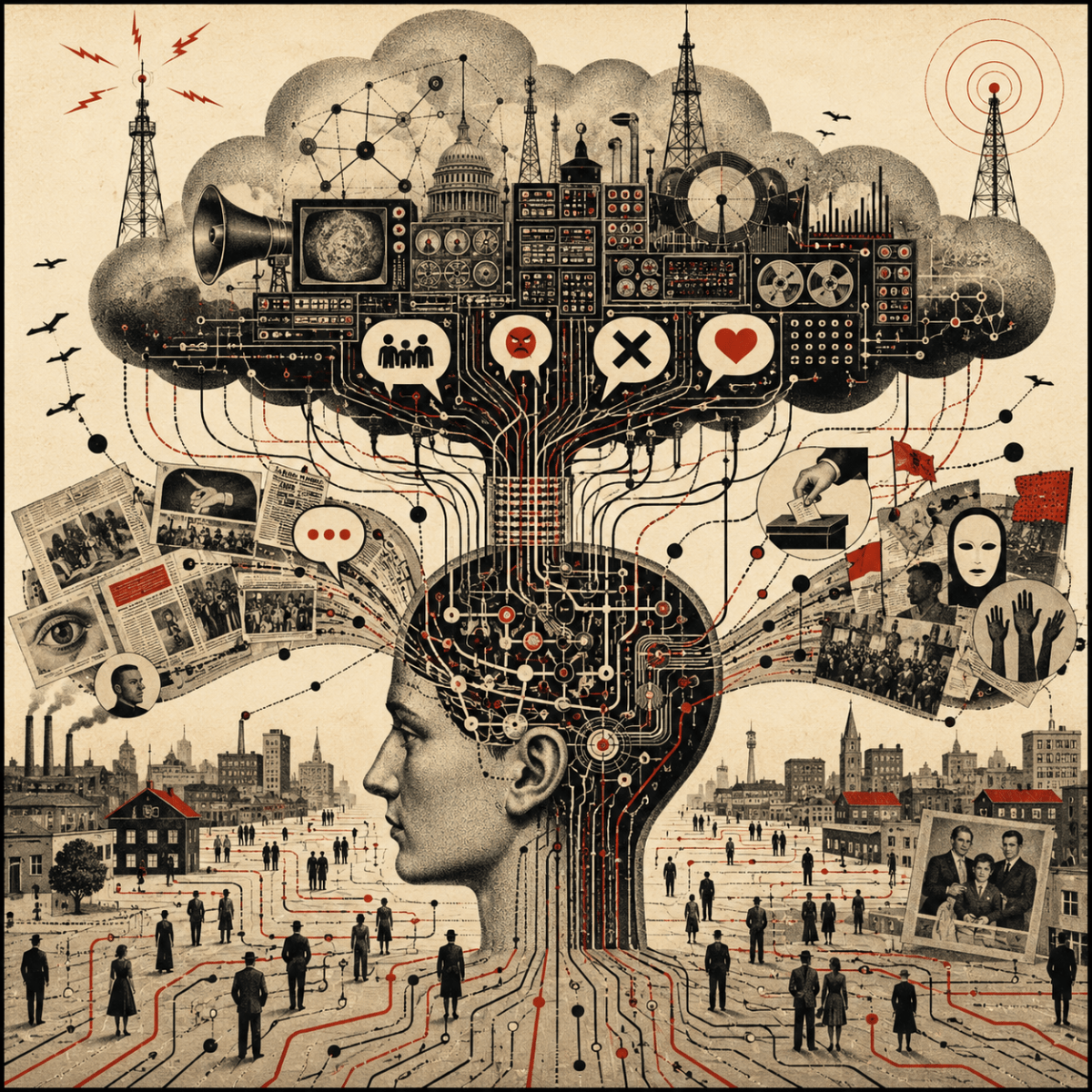
Cognitive bandwidth becomes cultural destiny. Not because intelligence vanishes, but because the carrying capacity of technologically mediated communication systems exceeds the carrying capacity of the biological minds living inside them. At that point, comprehension no longer primarily determines civilisation. Throughput does. Recurrence does. The system selects for whatever can survive transmission through informational density, fragmented attention, and constant adaptive volatility.
The horizon of comprehension is never purely individual. It is shaped by neurophysiology, memory, fatigue, symbolic compression, social reinforcement, and the ordinary limits of attention. Human cognition evolved inside slower ecological and interpersonal environments. Contemporary communication systems do not merely extend those capacities. They surround them, press upon them, and quietly reorganise them. The individual increasingly encounters reality through algorithmic filtration, emotional modulation, semantic acceleration, and probabilistic amplification. Meaning arrives already shaped by the system distributing it.
Under these conditions, communication adapts toward forms that maximise communication-system continuity. Cultural artefacts, political identities, outrage cycles, ideological fragments, and symbolic antagonisms are selected according to transmissibility rather than coherence. What survives is not necessarily what is accurate, ethical, or intellectually rigorous. It is what most efficiently reproduces itself across constrained cognitive bandwidth. Repetition substitutes for depth. Visibility substitutes for legitimacy. Activation substitutes for understanding.
This is not simply propaganda in the old sense. It is closer to a distributed ecological process occurring across billions of recursive interactions. Platforms optimise for engagement because engagement stabilises throughput. Participants adapt to the incentives surrounding visibility, identity, belonging, and social survival. Over time, communicative forms mutate toward high-transmission structures: simplified moral binaries, compressed identities, emotionally resonant abstractions, perpetual conflict states, and recombinant fragments of affiliation. The field learns what reproduces under pressure.
The system increasingly hovers at scales and levels of complexity that remain only partially intelligible to the minds participating within it. Causal chains lengthen. Consequences diffuse across networks. Feedback arrives delayed, displaced, or disguised. Under such conditions, belief systems become adaptive navigation structures inside environments too large to be directly perceived in full. Politics, media, institutions, markets, and culture begin to operate less like stable objects and more like entangled evolutionary fields shaped by recursive dependency, entropy, emergence, and collaborative adaptation under pressure.
At the edge of hyper-networked volatility, systems increasingly sustain themselves through adaptive communicative entanglement. Identity and communication become difficult to separate. Groups do not merely hold beliefs. They reproduce the informational conditions that allow those beliefs to remain socially and psychologically stable. The system rewards artefacts that intensify participation inside the field itself. Complexity is flattened into transmissible emotional geometry. Contradiction ceases to be a failure state and becomes structural fuel.
This chase condition is not incidental. The mind runs after the culture already reorganising it, while culture accelerates through the minds unable to fully contain it. The gap is the engine. It is a race condition between biological comprehension and technological transmission, but also a formative dynamical flow: a phase-space attractor in which complex systems sustain themselves by remaining unresolved, overstimulated, adaptive, and perpetually at risk. Risk is not external to the system. It becomes one of the conditions through which the system recognises itself, recruits attention, and reproduces participation.
This is also why the pattern is not merely technical. Human culture has always carried trauma: cities, villages, families, bodies, and lives negotiating hunger, violence, disability, grief, precarity, premature death, and the ordinary terror of being breakable. Technological communication systems inherit that historical substrate and amplify its signals. They do not invent vulnerability. They convert vulnerability into circulation.
The result is a civilisation in which cultural evolution is increasingly governed by the dynamics of communication systems rather than by the reflective capacities of isolated minds. Cognitive bandwidth becomes infrastructural. Attention becomes territorial. Semantic stability becomes probabilistic. Under sufficient informational pressure, the dominant attractor is not truth or falsity, but whichever pattern most successfully persists through recursive transmission across biological minds embedded inside technologically amplified fields of entropy.
Categories
Cognitive Bandwidth and the Politics of Belief
Cognitive bandwidth becomes cultural destiny because the carrying capacity of technologically mediated communication systems exceeds the carrying capacity of the biological minds living inside them.