01-DD

01-DD
02-DD

There are evenings where the sky itself appears aware of some immense and unspoken sadness, as though the atmosphere has briefly become conscious of time and cannot quite contain the weight of it. Not despair exactly. Not tragedy in the theatrical sense. Something older, quieter, and more pervasive than that. A diffuse melancholy without stable […]
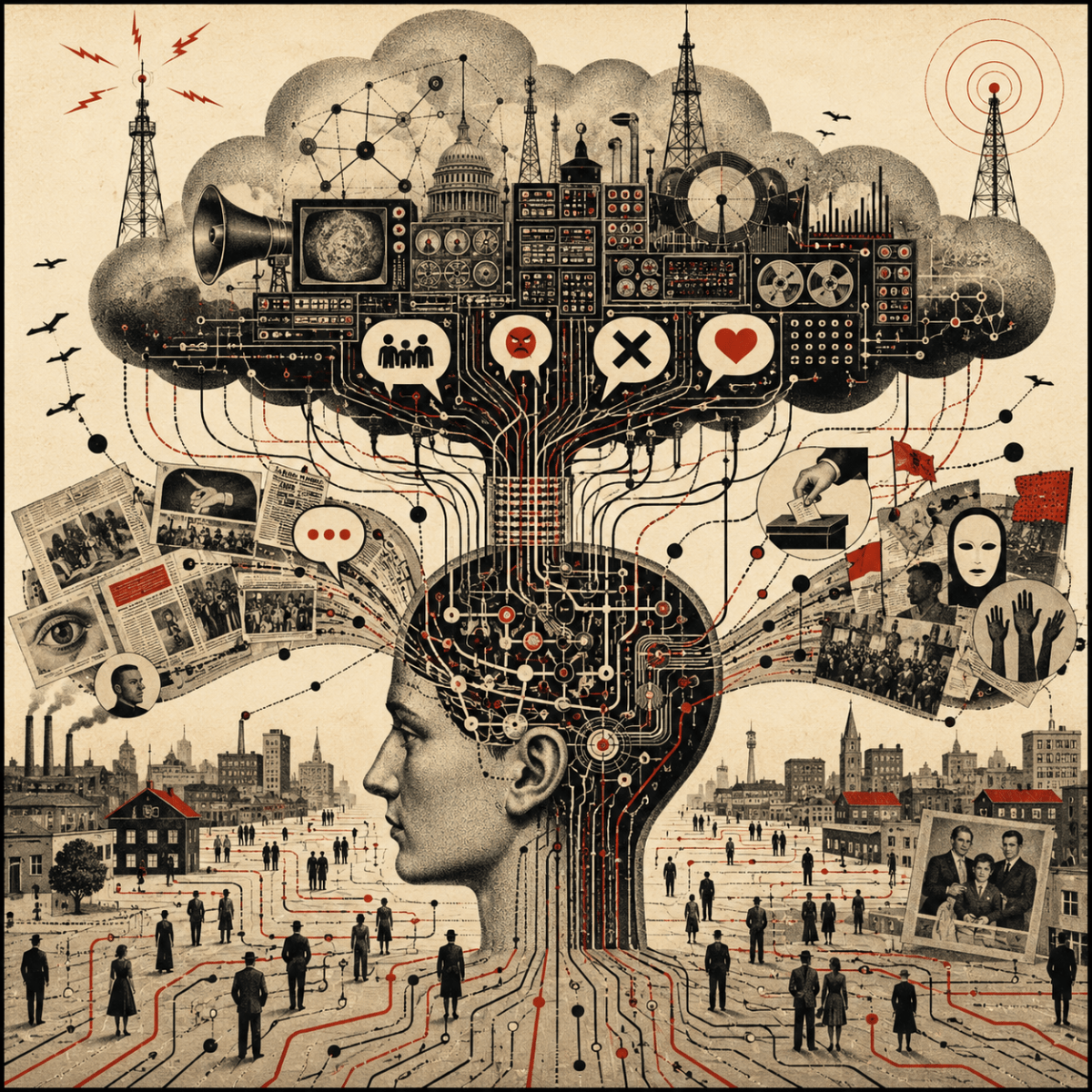
Cognitive bandwidth becomes cultural destiny because the carrying capacity of technologically mediated communication systems exceeds the carrying capacity of the biological minds living inside them.

The strange thing about prolonged conflict is not merely that it destroys. It reorganises perception. After enough cycles of outrage, retaliation, spectacle, counter-spectacle, sanctions, declarations, precision strikes, televised rubble, algorithmic tribalism, and strategic ambiguity, entire populations begin navigating reality through symbolic compression rather than direct experience. The war ceases to be geographically localised and instead […]

Politics is not failing because people have become irrational; it is failing because the systems that coordinate perception, timing, and response have slipped out of phase, and what we are experiencing as conflict, populism, volatility, and institutional drift is the visible surface of a deeper timing problem in large-scale communication systems, one that also describes […]

Formal Abstract This document presents a formal, process-based theory of language, information, and dynamic meaning systems. Communication, cognition, identity, legitimacy, and truth are treated not as static entities but as temporally constituted processes sustained through repetition, coupling, and feedback within distributed fields. A minimal axiom set grounded in acts, timing, coupling, recursion, variation, and emergent […]

Modern systems do not fail for lack of intelligence; they fail because intelligence cannot be sustained inside them. What disrupts institutional self-reproduction is neutralised, not because it is wrong, but because it shortens the cycle. That is the sustainability problem. A civilisation that cannot maintain its own capacity for understanding cannot respond coherently to anything […]
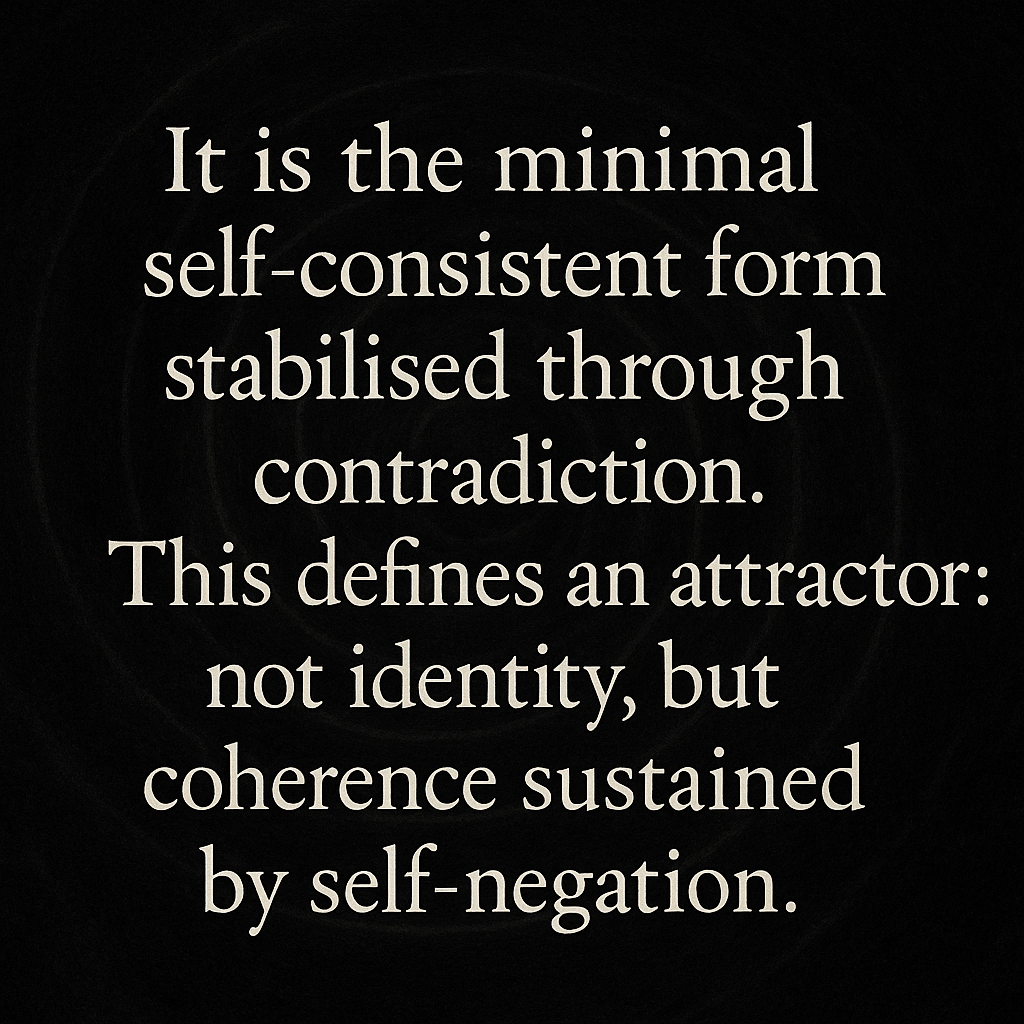
When people speak of nothing, they usually mean emptiness: no matter, no signal, no information. Yet absence is never encountered in isolation. Something is absent only in relation to an organisation for which it could have made a difference. Absence is not an object or an empty region waiting to be filled. It is the […]

The notion (articulated in the video) that the homeostatic process by which quasicriticality is maintained in the brain may have an essentially cybernetic explanation. In Jeff Hawkins’ “A Thousand Brains” he references neurophysiologist Vernon Mountcastle’s belief in the existence of an underlying (as unifying) organisational principle in the brain. I wouldn’t be at all surprised […]

