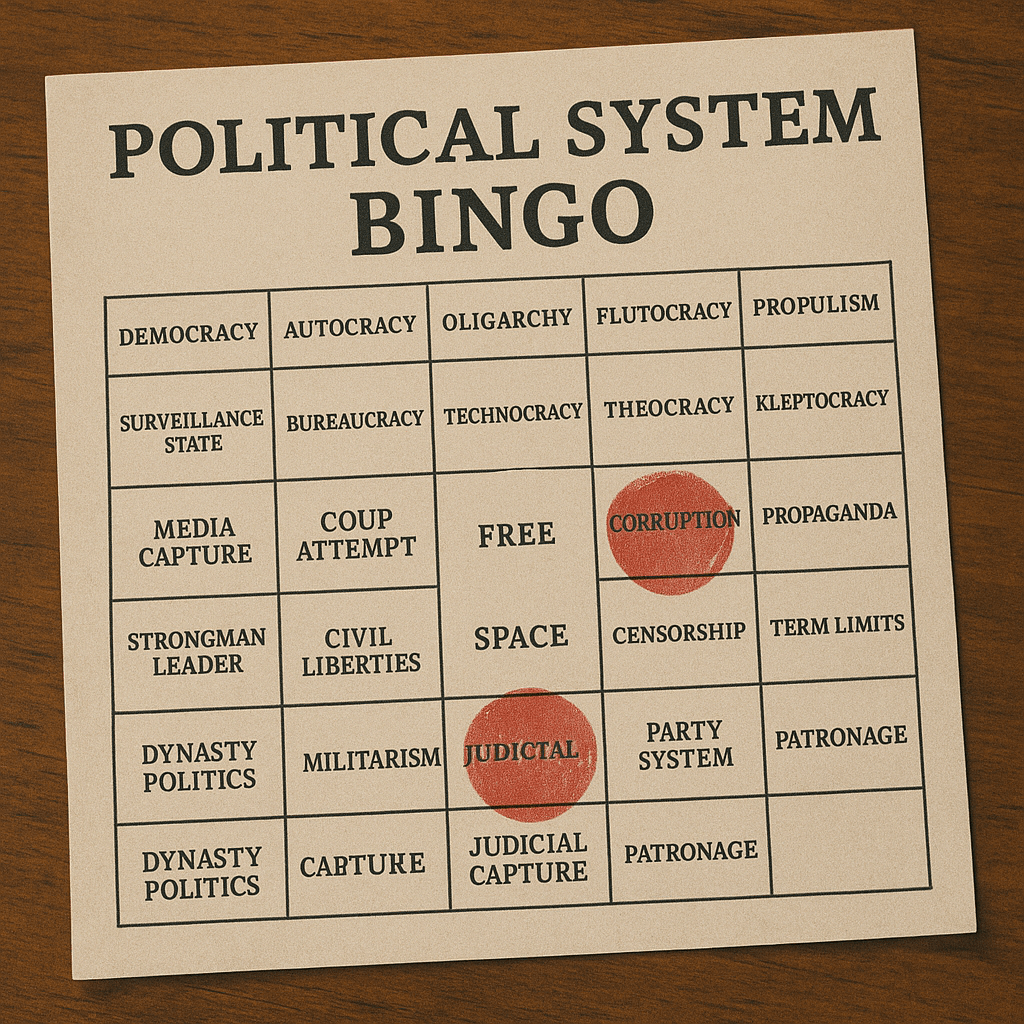
An autocratic turn rarely needs a mastermind. It grows in the fog between ambition and incompetence — statistical drift, not Machiavellian design. Greedy arrogance saturates every tier of (pretty much every) bureaucratic administration, but the deeper engine and self-propagating rationale is ashen banality: people who mistake obedience for insight, who follow momentum because they cannot […]
Category: culture
Sentinels of Survival: Mythic Conflict
The stories we inherit about war and history don’t just describe conflict; they compress it into forms we can carry. That simplification is partly necessary—communication always trims reality to fit inside language—but it also steers us toward the kinds of situations those stories claim to explain. Myths of courage, sacrifice, and righteous struggle arise after […]
When I was young, I was immersed in the full spectrum of popular culture—stories, myths, comics, and games that framed the world through conflict, difference, and the clean lines of good and evil. What later generations found in computer war games, I first found in Commando comics, Greek epics, Tolkien, and tabletop quests. These weren’t […]
Writing Without AI
It is a dying practise. Even as automation bludgeons narrative salience and nuance into the cognitively and culturally low-functioning relational slurry that it has now become, our thought patterns and socioeconomic reflexes adapt and align along with it. Try writing without AI. Feel the difference. That is natural intelligence. That is life.
More Words
Language is both the tool and the trap. We imagine ourselves steering it toward justice, order, or truth, yet language is steering us toward whatever best ensures its own survival. Our systems—legal, political, bureaucratic, technological—do not simply operate in language; they operate for it. Every new term, policy, and narrative strengthens the structures of description […]
Influence: Affective Resonance
Affective resonance is the synchrony that precedes understanding—the subtle entrainment of physiological and emotional states that aligns individuals before they think in unison. Like oscillators in the Kuramoto model, human nervous systems phase-lock through tone, cadence, and shared temporal fields. What we call meaning often arises only after this alignment has already occurred, retroactively justified […]
Words work before they mean. Long before comprehension, their rhythm, tone, and pattern capture attention. They anchor consciousness. This is semiosis at its rawest: symbols not yet parsed but already guiding perception. A word doesn’t just describe—it arranges how the mind listens, what it expects, and where it looks. Repetition, cadence, and emotional charge cultivate […]
Automating Extinction
Artificial intelligence will destroy us all only, or at least primarily, to the degree that human greed uses it as an amplifier. The destruction isn’t coming—it’s already underway.
Democracy is often assumed to be more resilient than it is. What is becoming clear in the United States is that its very openness—the freedoms of speech, assembly, and communication—provide the leverage points through which anti-democratic forces operate. If democratic systems can be bent or flipped using relatively low energy—disinformation campaigns, procedural manipulation, networked mobilization—then […]
Institutional Bullshit
Institutions are adept at naming their own failures but structurally incapable of addressing them. The bureaucratic cycle rewards discussion, reports, committees, and procedures that extend problems rather than resolve them. What gets called “management” is often the art of sustaining a tolerable stalemate, a perpetual negotiation that keeps the machinery alive without meaningfully engaging the […]
Insecure Political Identity
Conflict emerges not as a necessity but as a probabilistic orientation, seeded by inherited biological reflexes and cultural traditions that tilt cognition toward opposition. The self-determining narratives that grow from this inclination reinforce and entrench opposition until behaviours and thought patterns sustain the narrative above and beyond any substantive rationale for it. Evolutionary pressures honed […]
Analysis is always double-edged. To describe how a system functions is also to provide a how-to, a cookbook for replication. You don’t need to intend it. The moment you show how the parts connect, you’ve revealed the pattern, and anyone watching can use that knowledge to tighten the loop. This isn’t limited to ideology or […]