Categories
cybernetics

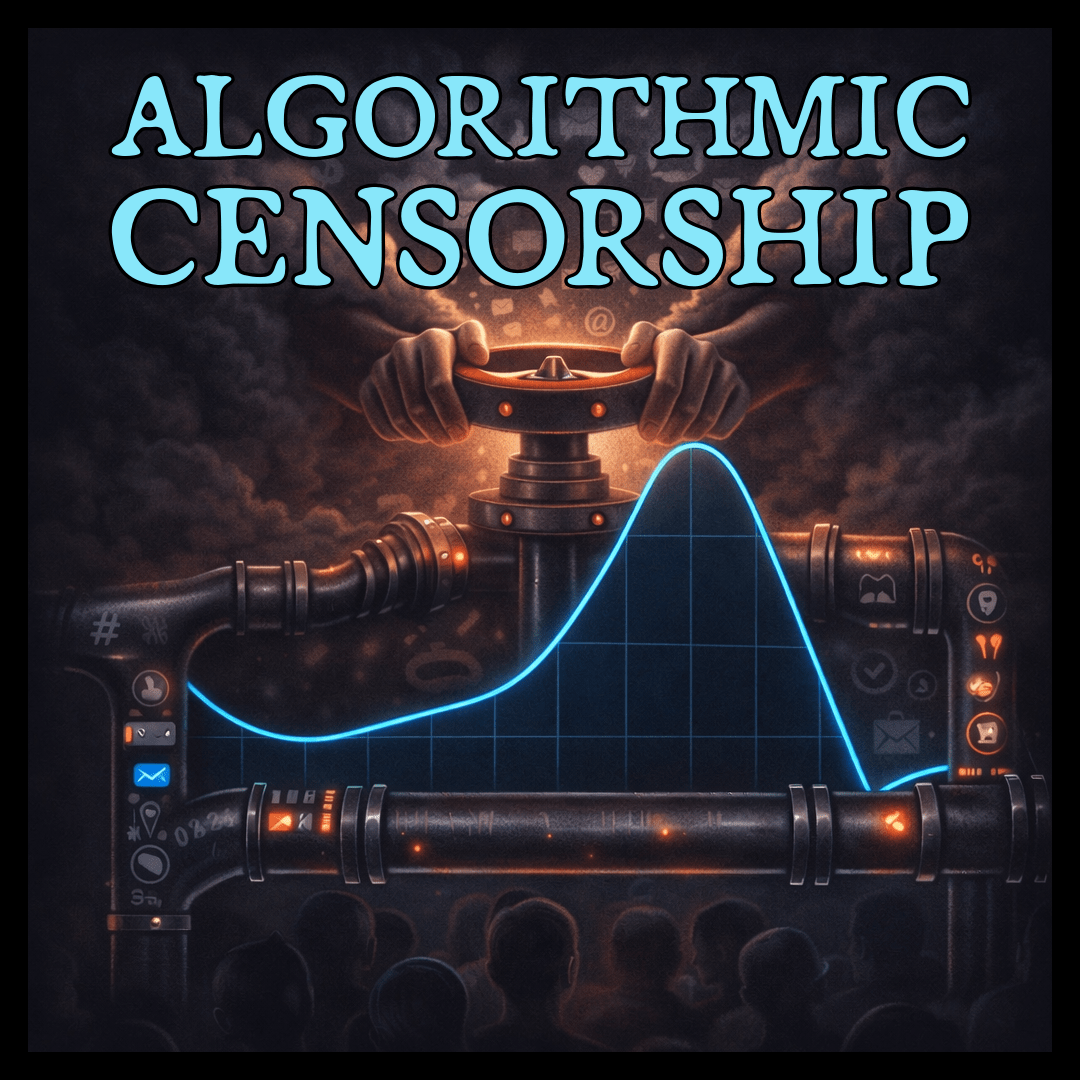
Algorithmic Censorship

Across the major platforms, something subtle but consistent is happening. Posts rise, gather momentum, then stall at almost exactly the same threshold, regardless of topic, audience, or timing. The curve flattens not because interest disappears, but because propagation is capped. This pattern repeats on LinkedIn, WordPress, X, Instagram, and beyond. Visibility has become a controlled […]

Categories
cybernetics

Conflict: Metaphysics of Non-Closure

Conflict and competitive adversarialism are not necessarily moral failures or aberrations. They are contingent, historically acquired, culturally entrained mechanisms by which complex cognitive, cultural, and communicative systems reliably differentiate, learn, and reproduce themselves over time. These mechanisms arise because complexity does not form around completeness, nor does it arise from closure, certainty, or final resolution. […]

Categories
physics

Quantum Confusion: Institutional Inertia

We are taught to treat quantum mechanics as intrinsically strange, opaque, almost hostile to intuition. The standard story is that reality itself is bizarre, and that only extreme mathematical sophistication grants partial access to it. Yet this framing quietly ignores another possibility: that many workable intuitions, partial models, and genuinely useful ways of thinking never […]

Categories
Philosophy

[01] Disinformation Dynamics: Unified Framework

Series preamble: this series of documents is an educated guess. I study complexity, communication, and culture. The underlying harmonic structure should be evident to anyone with a passing familiarity with physics, mathematics, or logic. Manifold dynamics provide a topological bridge to and through communication systems, and in some sense are those systems. Disinformation functions here […]

Categories
Philosophy

[02] Disinformation Dynamics: Recursive Harmonics

2.1 Coherence as a Function of Recursion Every communication system is recursive. It consists of elements that transmit signals influencing their own subsequent states. This self-reference produces coherence. A message gains meaning not because it exists but because it is repeated, referenced, and reinterpreted. Without recursion, meaning is static. With recursion, meaning becomes dynamic and […]

Categories
Philosophy

[03] Disinformation Dynamics: Interdiction Operations

3.1 Measurement Philosophy Measurement in recursive harmonic systems does not isolate variables; it captures relationships. Every observation modifies what is observed, because communication systems are reflexive. Therefore, measurement itself must be designed as participation in the field—an act of modulation that respects feedback dynamics. The goal is not to determine truth but to detect phase […]

Categories
Philosophy

[04] Disinformation Dynamics: Operational Framework

4.1 Overview Disinformation interdiction is not the elimination of falsehood but the rebalancing of systemic coherence. It operates at the level of phase relationships—how signals align and reinforce one another—rather than semantic truth. The objective is to restore dynamic equilibrium: sufficient synchrony for stability, sufficient noise for adaptability. The system must breathe. Interdiction therefore proceeds […]

Categories
Philosophy

[05] Disinformation Dynamics: Implementation and Resilience

5.1 The Principle of Reflexive Governance Governance within a recursive communication field cannot rely on static regulation. It must function as reflexive control—a governance system that perceives and adjusts its own influence in real time.Each intervention becomes a feedback signal: the regulator is part of the system, not external to it.This principle ensures adaptability without […]

Categories
Philosophy

[06] Disinformation Dynamics: Simulation,  Forecasting, Adaptation

6.1 The Need for Predictive Reflexivity Static policy and reactive moderation fail because communication systems evolve faster than any predefined rule.Disinformation interdiction therefore requires predictive reflexivity—a capacity to anticipate systemic states by modelling their feedback structures. Forecasting in this framework is not prediction of content but simulation of phase evolution: how coherence, entropy, and recursivity […]