Categories
cybernetics logic Philosophy systems

The Problem of Many Spaces

Living systems, space, and coherence Living systems do not operate in a single space in the sense of a bounded domain, nor do they truly inhabit many distinct ones; rather, they instance a continuous relational field whose articulation into behavioural, transcriptional, morphological, physiological, and symbolic sub-spaces constitutes its harmonic structure, not a reduction of it. […]

Categories
cybernetics

AI Companions

AI companionship is a downstream expression of a much older dependency: the tendency to mistake symbolic coherence for certainty, and patterned response for agency. Language evolved pari passu, along with neurochemistry, but the structure it expresses is not confined to language, technology, or even cognition. It reflects a deeper dynamic by which systems persist through […]

Categories
Philosophy

Atlas, Debugged

I no longer believe the world can be healed by better arguments, smarter policies, cleaner data, or more sophisticated machines. These things mostly just turn the volume up on whatever is already broken. The deeper condition is non-closure: the simple fact that complex systems do not stabilise by resolving tension, but by holding it in […]

Categories
cybernetics

The Geometry of the Unconscious

The unconscious is not a hidden chamber beneath awareness, nor a secondary mind running in parallel. It is the emergent interior of dynamical, adaptive, relational complexity itself. It is what complex systems feel like from the inside. Any system capable of learning, anticipation, coordination, and self-regulation must generate internal structure that cannot be fully present […]

Categories
cybernetics

On the Structural Limits of Political Language

Victor Klemperer’s The Language of the Third Reich was written under conditions that were materially, professionally, and existentially constraining. As a Jewish academic in Nazi Germany, he was excluded from public life, subject to surveillance, and deprived of institutional protection. The book did not emerge as a theoretical project but as a record: observations accumulated […]

Categories
cybernetics

Field Logic and Semiotics

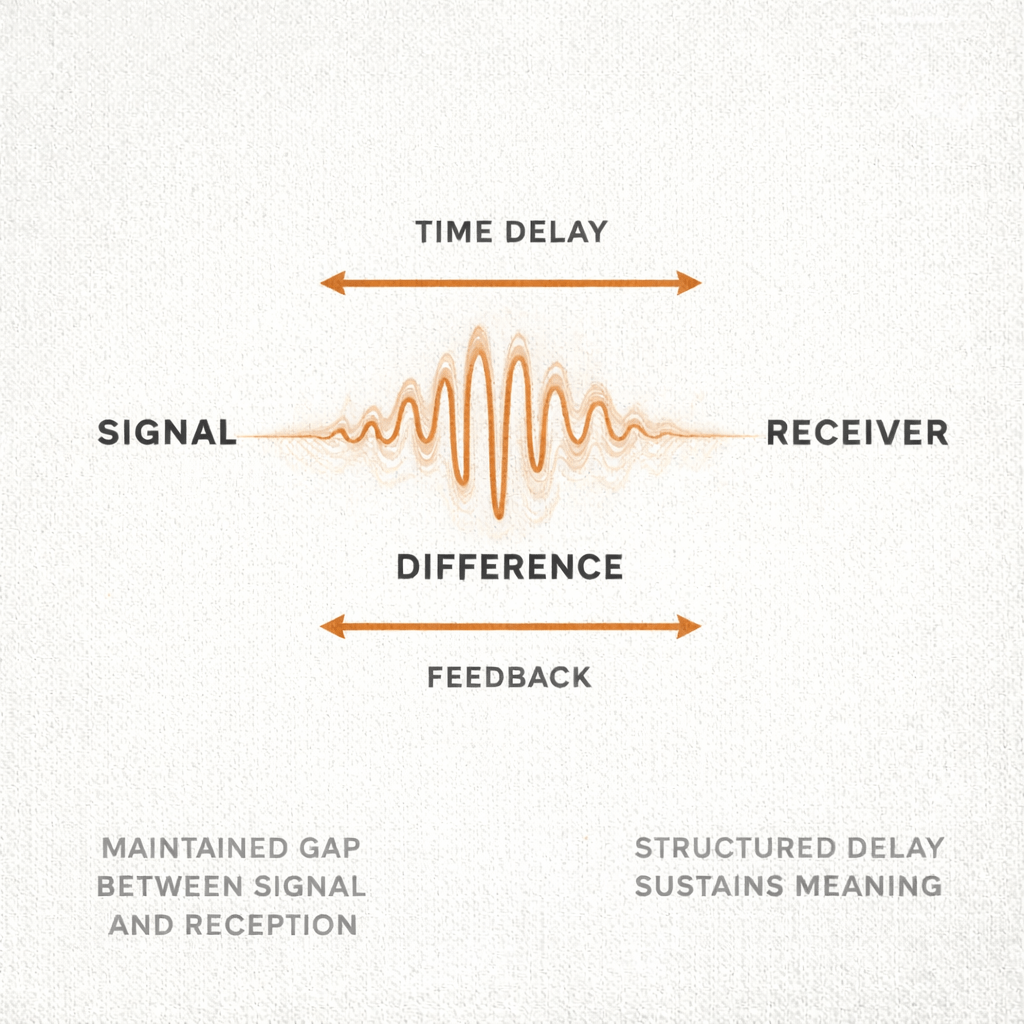
This essay advances a limited but precise claim: meaning in communicative systems depends on structured delay, and that delay is constitutive of causal relations rather than incidental to them. Where there is a point of emission and a point of reception, the signal that passes between them is not merely a connector. It participates in […]

Categories
language

Symbolic Traffic

Language is a game in which winning, or apparent success, is characterised, celebrated, and sustained by the relational value of tokens within it. What actually wins is the communication system itself. Human projects, without exception, are functions of belief within language, of language. Success is the generation of more language. Wealth, politics, and sociocultural dominance […]

Categories
Philosophy

[01] Disinformation Dynamics: Unified Framework

Part 1 — Executive Summary and Scope Modern communication systems—political, technological, and cognitive—operate as self-organising fields of feedback. Their coherence does not arise from authority, ideology, or truth, but from rhythm: the timing, repetition, and resonance of interaction. Disinformation exploits this rhythm. It is not merely falsehood, but a manipulation of synchrony, coherence, and recursion—the […]

Categories
Philosophy

[03] Disinformation Dynamics: Interdiction Operations

3.1 Measurement Philosophy Measurement in recursive harmonic systems does not isolate variables; it captures relationships. Every observation modifies what is observed, because communication systems are reflexive. Therefore, measurement itself must be designed as participation in the field—an act of modulation that respects feedback dynamics. The goal is not to determine truth but to detect phase […]

Categories
Philosophy

[04] Disinformation Dynamics: Operational Framework

4.1 Overview Disinformation interdiction is not the elimination of falsehood but the rebalancing of systemic coherence. It operates at the level of phase relationships—how signals align and reinforce one another—rather than semantic truth. The objective is to restore dynamic equilibrium: sufficient synchrony for stability, sufficient noise for adaptability. The system must breathe. Interdiction therefore proceeds […]

Categories
Philosophy

[05] Disinformation Dynamics: Implementation and Resilience

5.1 The Principle of Reflexive Governance Governance within a recursive communication field cannot rely on static regulation. It must function as reflexive control—a governance system that perceives and adjusts its own influence in real time.Each intervention becomes a feedback signal: the regulator is part of the system, not external to it.This principle ensures adaptability without […]

Categories
Philosophy

[06] Disinformation Dynamics: Simulation,  Forecasting, Adaptation

6.1 The Need for Predictive Reflexivity Static policy and reactive moderation fail because communication systems evolve faster than any predefined rule.Disinformation interdiction therefore requires predictive reflexivity—a capacity to anticipate systemic states by modelling their feedback structures. Forecasting in this framework is not prediction of content but simulation of phase evolution: how coherence, entropy, and recursivity […]