Categories
cybernetics

Global Field Logic

Applying field logic to the global socio-economy means treating politics not as the source of direction but as a surface articulation of deeper structural dynamics. By field logic, I mean understanding social, economic, and technological systems as continuous relational environments that shape what can stabilise, propagate, or decay before intention, belief, or ideology come into […]

Categories
Philosophy

Hollow States

No complex system is complete, and none ever settles into final coherence. It persists by operating near its own failure modes, always collapsing toward equilibrium without arriving there. This condition is not exceptional; it is constitutive. Collapse is not what ends systems, but what allows them to reproduce themselves. Systems endure by continuously redistributing error, […]

Categories
Philosophy

Absurd Superficiality

The absurdity of the social media game is structural, not moral. Everyone is incentivised to speak, assert experience, belief, or fact, yet attention is allocated to whatever compresses fastest. To be heard, meaning is thinned, context stripped, time and place over-determined into slogans. Throughput beats processing. What looks like participation is actually a selection regime […]

Categories
cybernetics

Governance as Harmonic Coordination

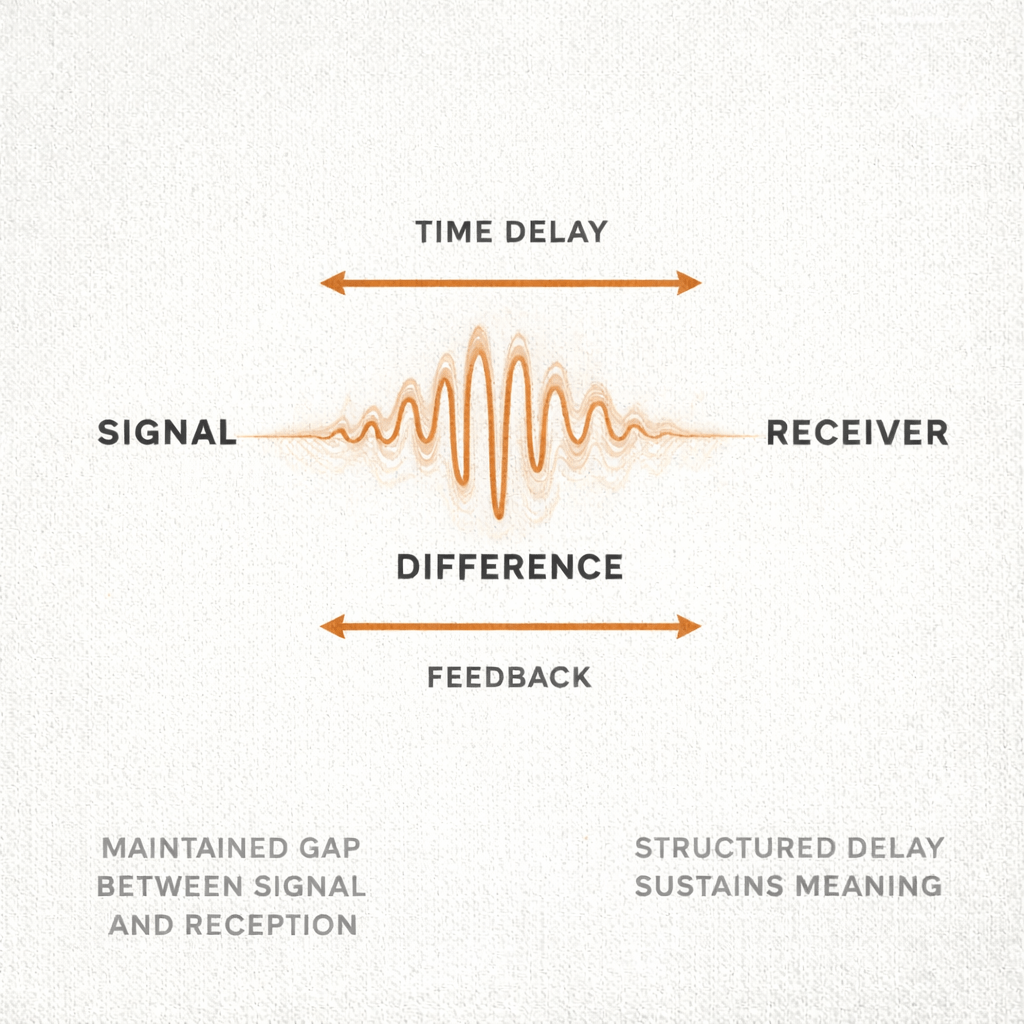
Governance can be understood as the management of phase relations within an ensemble, not the enforcement of uniform behaviour. In any governed system—social, institutional, technical, or ecological—coherence does not arise from fixing positions or eliminating difference. It arises from partial synchronisation: agents align enough to act collectively while remaining out of phase enough to retain […]

Categories
Psychology

Vanishing Point: Self-ish

The self is commonly understood as something one has: a centre of experience, a point of view, a continuous “me” that persists through time. Psychological models tend to formalise this intuition by treating the self as a representational structure—narrative continuity, minimal experiential core, or predictive model—through which coherence can be maintained. This move is not […]

Categories
Philosophy

Suggestibility

…any system complex enough to interpret must remain vulnerable to the modulation of its own interpretive dynamics…

Categories
Philosophy

[01] Disinformation Dynamics: Unified Framework

Series preamble: this series of documents is an educated guess. I study complexity, communication, and culture. The underlying harmonic structure should be evident to anyone with a passing familiarity with physics, mathematics, or logic. Manifold dynamics provide a topological bridge to and through communication systems, and in some sense are those systems. Disinformation functions here […]

Categories
Philosophy

[02] Disinformation Dynamics: Recursive Harmonics

2.1 Coherence as a Function of Recursion Every communication system is recursive. It consists of elements that transmit signals influencing their own subsequent states. This self-reference produces coherence. A message gains meaning not because it exists but because it is repeated, referenced, and reinterpreted. Without recursion, meaning is static. With recursion, meaning becomes dynamic and […]

Categories
Philosophy

[03] Disinformation Dynamics: Interdiction Operations

3.1 Measurement Philosophy Measurement in recursive harmonic systems does not isolate variables; it captures relationships. Every observation modifies what is observed, because communication systems are reflexive. Therefore, measurement itself must be designed as participation in the field—an act of modulation that respects feedback dynamics. The goal is not to determine truth but to detect phase […]

Categories
Philosophy

[04] Disinformation Dynamics: Operational Framework

4.1 Overview Disinformation interdiction is not the elimination of falsehood but the rebalancing of systemic coherence. It operates at the level of phase relationships—how signals align and reinforce one another—rather than semantic truth. The objective is to restore dynamic equilibrium: sufficient synchrony for stability, sufficient noise for adaptability. The system must breathe. Interdiction therefore proceeds […]

Categories
Philosophy

[05] Disinformation Dynamics: Implementation and Resilience

5.1 The Principle of Reflexive Governance Governance within a recursive communication field cannot rely on static regulation. It must function as reflexive control—a governance system that perceives and adjusts its own influence in real time.Each intervention becomes a feedback signal: the regulator is part of the system, not external to it.This principle ensures adaptability without […]

Categories
Philosophy

[06] Disinformation Dynamics: Simulation,  Forecasting, Adaptation

6.1 The Need for Predictive Reflexivity Static policy and reactive moderation fail because communication systems evolve faster than any predefined rule.Disinformation interdiction therefore requires predictive reflexivity—a capacity to anticipate systemic states by modelling their feedback structures. Forecasting in this framework is not prediction of content but simulation of phase evolution: how coherence, entropy, and recursivity […]