Categories
cybernetics

Unfinished Systems

Large systems of power, regulation, ideology, and identity do not stabilise by winning or resolving the problems they address. They stabilise by remaining unfinished. Political institutions, security apparatuses, markets, cultural movements, and ideological projects sustain themselves by managing problems they cannot conclusively solve: inequality, threat, disorder, legitimacy, desire, dissent. Total control would terminate their function. […]

Categories
cybernetics

Institutional Machinery of Self-Description

Large institutional systems do not merely maintain narratives about what they are doing or why they are doing it. They stabilise meta-procedures: how statements are produced, validated, circulated, and sanctioned, because at scale the reasons matter less than the repeatability of the process. These methods become the true object of protection because they allow coordination […]

Categories
Philosophy

Moral Inversion

Nietzsche’s The Antichrist was not written to identify a villain in the conventional sense. It was an intervention aimed at disturbing complacency. His target was not a person, but a reversal: a situation in which values publicly affirmed as moral, spiritual, or redemptive had become detached from the practices and dispositions they purported to sanctify. […]

Categories
Philosophy

Structural Insecurity Precedes Moral Failure

Racism, misogyny, and other forms of exclusion recur not because they are compelling, justified, or desirable, but because large-scale social systems are biased toward generating them, or things like them, under stress. Calling this structural does not mean denying choice. People do make choices, good, bad, and ugly, and they live with the consequences of […]

Categories
cybernetics

Technocratic Tyrrany

We use technologies that also use us. Over time, methods are formalised into metrics, metrics are stabilised into categories of meaning, and tools designed to assist begin to define which actions are recognised as valid. What once supported activity becomes background infrastructure. The tools move to the centre. Human experience no longer anchors them; it […]

Categories
cybernetics

Why an Autocratic Turn is Catastrophic

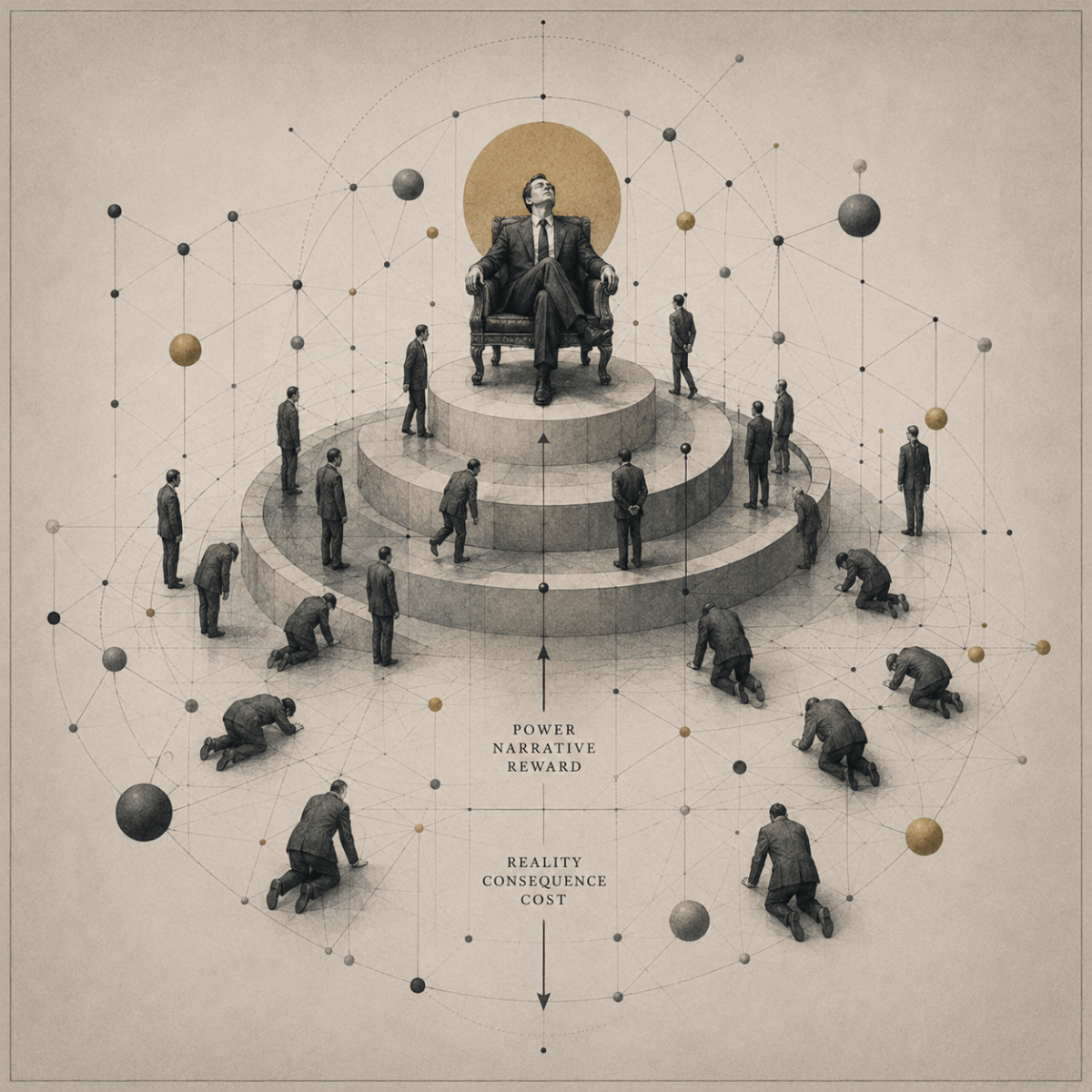
An autocratic turn accelerates self-destructive collapse not because it is immoral, but because it forces a distributed system into a shape it cannot sustain. Short-term unity is purchased by suppressing variation, and the centre begins to confuse resistance with disobedience rather than information about system limits. Feedback from courts, states, agencies, markets, and elections is […]

Categories
cybernetics language Philosophy

Living Inside Language

We learn to navigate the world by drawing lines through it. Self and other. Mind and world. Human and machine. These distinctions help us function, the way handrails help us walk down unfamiliar stairs. They stabilise action and expectation. But they are not where reality begins. They are not built into the fabric of existence. […]

Categories
history

Repeats

The same neurotic insecurities recur: pathological closure of language, minds, borders, and culture, converging into a perfect storm of radical ideology, technocratic overreach, and blind, arrogant greed.

Categories
cybernetics

Philosophy of Language

My position is that the most consequential features of language, meaning, and coordination cannot be exhaustively defined without being distorted, and that this is a structural necessity rather than a theoretical shortcoming. Certain terms must be taken as primitive, not out of convenience, but because definition is itself a secondary operation, already dependent on relational […]

Categories
cybernetics

After

If the United States survives their current political apoplexy, there is a genuine possibility of reconstruction, but only because damage exposes the relationships that mattered and brings hidden dependencies into the open, revealing how the system was actually held together. The damage being inflicted is real and severe, economic and political at once. Disruption to […]

Categories
cybernetics

Conflict: Metaphysics of Non-Closure

Conflict and competitive adversarialism are not necessarily moral failures or aberrations. They are contingent, historically acquired, culturally entrained mechanisms by which complex cognitive, cultural, and communicative systems reliably differentiate, learn, and reproduce themselves over time. These mechanisms arise because complexity does not form around completeness, nor does it arise from closure, certainty, or final resolution. […]

Categories
Philosophy

Predatory Opportunism in University Systems

University systems are not simply organised around knowledge, discovery, or intellectual community. Those are decorative claims. The real game is status. Universities function as credential factories and hierarchy-maintenance machines, where prestige, funding position, and reputational insulation matter far more than whether anything true, useful, or unsettling is learned. This is predatory opportunism in institutional form. […]