Categories
cybernetics

Conflict: Metaphysics of Non-Closure

Conflict and competitive adversarialism are not necessarily moral failures or aberrations. They are contingent, historically acquired, culturally entrained mechanisms by which complex cognitive, cultural, and communicative systems reliably differentiate, learn, and reproduce themselves over time. These mechanisms arise because complexity does not form around completeness, nor does it arise from closure, certainty, or final resolution. […]

Categories
Philosophy

Philosophical Alienation

Consciousness entails perspectival isolation. Subjective experience is necessarily local, bounded by the fact that one mind does not have direct access to another. Philosophy of mind, phenomenology, and cognitive science converge on this constraint, whether framed as first-person authority, privacy of qualia, or irreducible point of view. Language does not remove this barrier. It operationalises […]

Categories
cybernetics

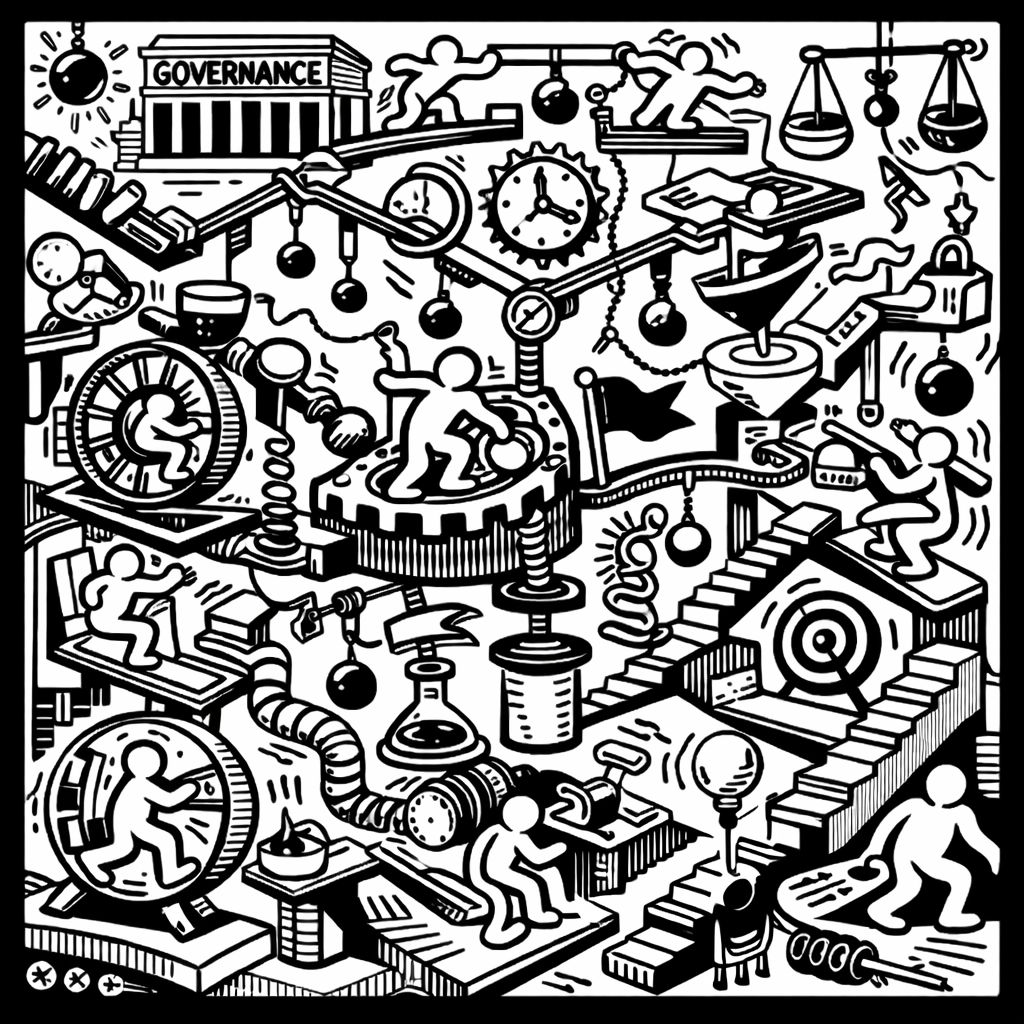
Governance as Harmonic Coordination

Governance can be understood as the management of phase relations within an ensemble, not the enforcement of uniform behaviour. In any governed system—social, institutional, technical, or ecological—coherence does not arise from fixing positions or eliminating difference. It arises from partial synchronisation: agents align enough to act collectively while remaining out of phase enough to retain […]