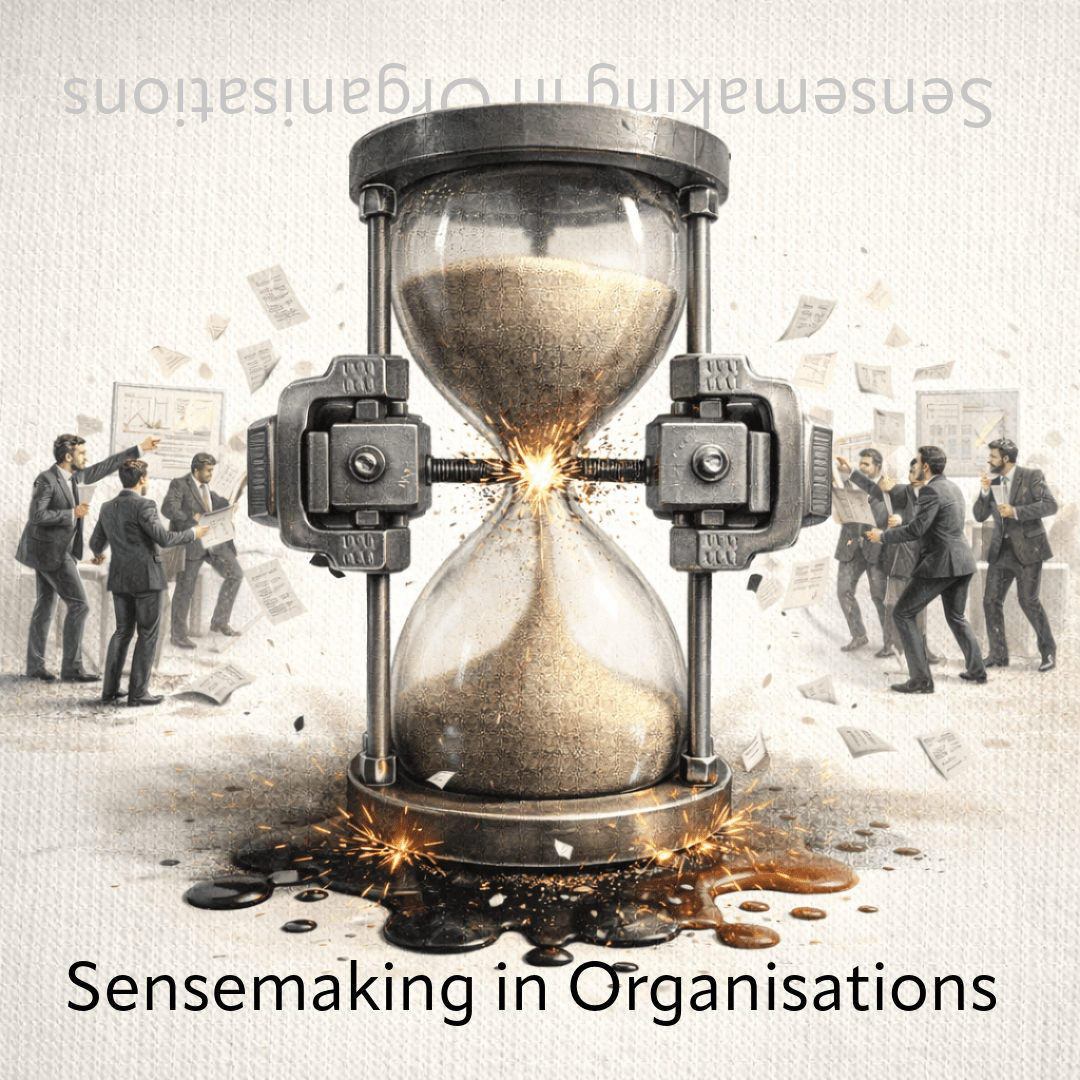
Politics is not failing because people have become irrational; it is failing because the systems that coordinate perception, timing, and response have slipped out of phase, and what we are experiencing as conflict, populism, volatility, and institutional drift is the visible surface of a deeper timing problem in large-scale communication systems, one that also describes […]
Categories
Failure Mode: How Politics Lost Its Groove
- Post author By G
- Post date Mar 19, 2026
- No Comments on Failure Mode: How Politics Lost Its Groove

- Tags adaptive-systems, attention economy, cognitive systems, communication systems, communication theory, complexity and society, complexity science, cultural dynamics, cybernetics, delay and feedback, distributed cognition, entropy and communication, feedback loops, field logic, governance systems, information overload, information theory, institutional trust, language and power, logical orbit, media dynamics, media ecology, network dynamics, nonlinear systems, orbit frame, perception and cognition, phase misalignment, policy design, political systems, populism analysis, relational dynamics, semantic drift, signal processing, social systems, socio-technical systems, symbolic systems, system architecture, systemic risk, systems theory, technological acceleration, timing and coordination







 Daedelus Kite