Categories
cybernetics

Wiener–Khinchin theorem

The Wiener–Khinchin theorem describes a quiet inevitability: when a system repeats itself, even imperfectly, that repetition condenses into structure. Time leaves a trace. Signals that return, echo, or correlate with their own past do not merely accumulate; they reorganise into a spectrum, a distribution of emphasis and weight. What looks like flux from within time […]

Categories
Philosophy

Truth in Language

What is truth. The moment we ask the question, we are already inside language, and everything that follows unfolds from that fact. Truth is not something we approach from outside, as a detached observer might inspect an object. It arises within sequences of tokens, within the games we play with them, within the structures we […]

Categories
cybernetics

Effective Writing with Language Models

This is not about asking a model to generate ideas for you. It is about placing your own thinking into a responsive medium so it can be worked. You bring partial arguments, intuitions, constraints, and unresolved tensions. The model reflects them back through selective amplification: adjacent phrasings, shifts in emphasis, alternative structures. That amplification makes […]

Categories
Philosophy

The Infinite

The infinite is an idea we return to not because it resolves questions, but because it resists resolution. We surround it with language, belief, argument, and ritual, attempting to stabilise what cannot be fixed. There are no receipts for the purchase. Any infinity exceeds its description, regardless of how carefully the conceptual scaffolding is constructed. […]

Categories
Philosophy

The Big Empty: Consciousness, Cosmos, and the Generative Logic of Absence

In a holistic system, every reference is internal. Nothing outside the system provides direction or meaning. Order emerges because each component must stabilise itself through relations that close back into the whole. The universe maintains coherence by reorganising its own activity; consciousness constructs a world by interpreting the patterns it generates. Both are self-contained structures […]

Categories
communication

More Words

Language is both the tool and the trap. We imagine ourselves steering it toward justice, order, or truth, yet language is steering us toward whatever best ensures its own survival. Our systems—legal, political, bureaucratic, technological—do not simply operate in language; they operate for it. Every new term, policy, and narrative strengthens the structures of description […]

Categories
cybernetics

Language

Abstract: This essay explores how civilisation’s systems—political, economic, and technological—emerge from a mistaken belief that language contains the world, when in truth the world contains our descriptions. The error of equating description with reality is not an isolated flaw but endemic to the distributed, manifold-like topology of semantics itself: uncertainty is not peripheral but woven […]

Categories
Philosophy

The Logic that Lives

Life, in its most abstract sense, is a contradiction that refuses to resolve. It persists as a dynamic equilibrium between forces that can never perfectly align. Every organism, idea, or particle exists not by finding rest but by orbiting imbalance—by sustaining tension as continuity. The living field is not static; it is recursive, a looping […]

Categories
Philosophy

Living Energy Fields

Peter Mitchell was a British biochemist who transformed biology by introducing the chemiosmotic theory — the idea that cells generate energy through electrochemical gradients across membranes, overturning the then-dominant mechanistic view of metabolism. “I cannot consider the organism without its environment… from a formal point of view the two may be regarded as equivalent phases […]

Categories
cybernetics

General Intelligence

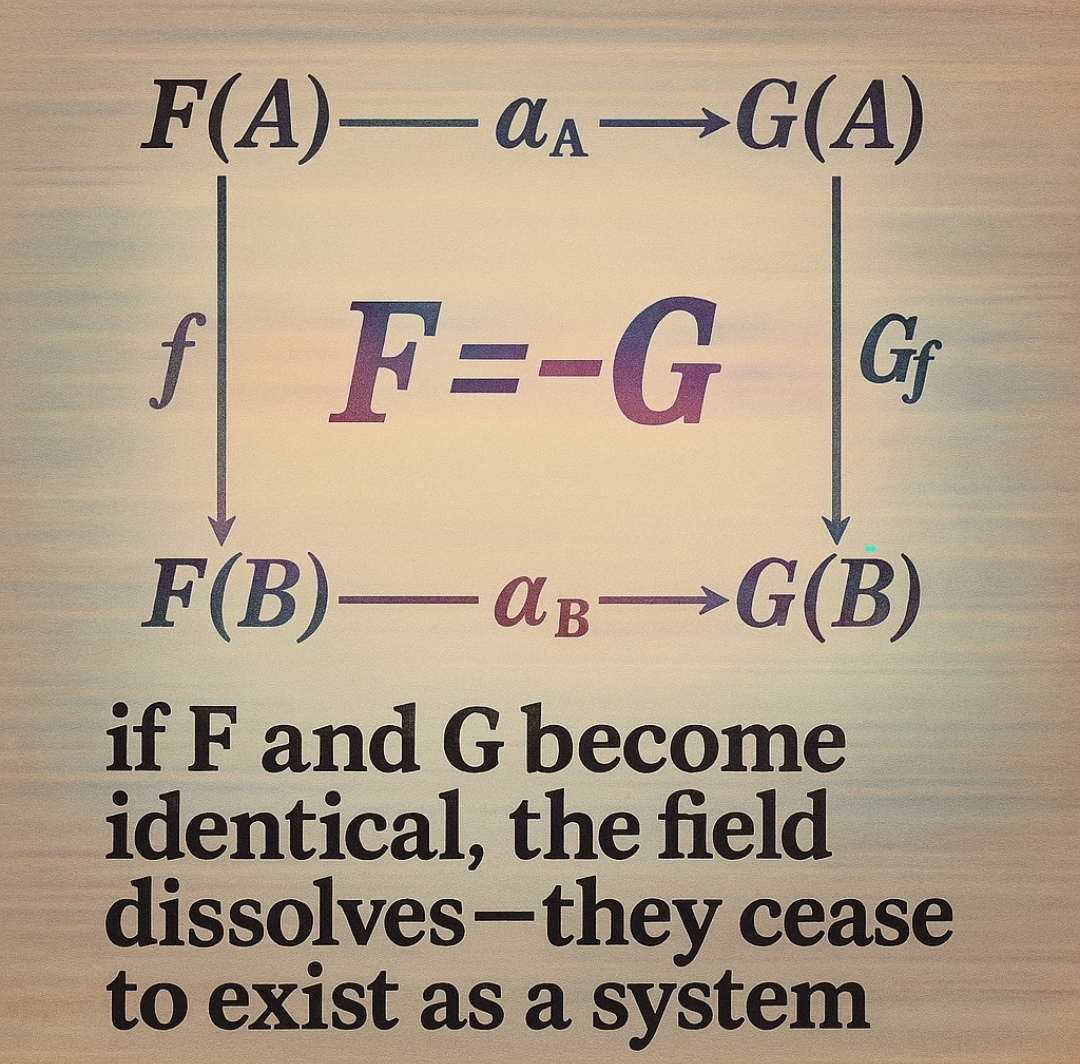
Imagine F and G as two interdependent operations—each defining the other through difference. F acts as a generator: it constructs hypotheses, projections, or internal states. G acts as a comparator: it evaluates, reflects, and reintroduces the outcomes of F back into the system. The diagram’s symmetry, where F = − G, indicates an inversion rather […]

Categories
cybernetics

Disinformation Dynamics

Meaning is what remains coherent under transformation, yet in living communicative systems the transformations themselves evolve, so what counts as invariant shifts over time. Meaning does not arise from stable signals but from oscillation, delay, ambiguity, and relational difference, where coherence emerges through dynamic offset rather than agreement. Communication stabilises not through convergence but through […]

Categories
Philosophy

Holism: Everything, Everywhere, All at Once

From the outset, holism concerns not wholes but the strange seam between parts. From Plato’s Forms and Spinoza’s substance to cybernetics, ecology, and dynamical systems, holism persists as an intuition of unity. Each turn sought not larger aggregates but subtler grammars of interaction—non-linear feedbacks, attractor basins, emergent orders. Unorthodox approaches—Prigogine’s dissipative structures, Bohm’s implicate order, […]