Categories
cybernetics

Time, Delay and Systems Theory: Vortex Dynamics

Dynamical structure reveals itself through the propagation of signals. We do not encounter systems first as finished objects and only later as processes; we encounter them through motion, response, transmission, lag, and constraint. Signals move through fields and never arrive instantly. Delay is therefore not an imperfection added to an otherwise complete world. It is […]

Categories
cybernetics logic Philosophy systems

The Problem of Many Spaces

Living systems, space, and coherence Living systems do not operate in a single space in the sense of a bounded domain, nor do they truly inhabit many distinct ones; rather, they instance a continuous relational field whose articulation into behavioural, transcriptional, morphological, physiological, and symbolic sub-spaces constitutes its harmonic structure, not a reduction of it. […]

Categories
cybernetics

AI Companions

AI companionship is a downstream expression of a much older dependency: the tendency to mistake symbolic coherence for certainty, and patterned response for agency. Language evolved pari passu, along with neurochemistry, but the structure it expresses is not confined to language, technology, or even cognition. It reflects a deeper dynamic by which systems persist through […]

Categories
Philosophy

Atlas, Debugged

I no longer believe the world can be healed by better arguments, smarter policies, cleaner data, or more sophisticated machines. These things mostly just turn the volume up on whatever is already broken. The deeper condition is non-closure: the simple fact that complex systems do not stabilise by resolving tension, but by holding it in […]

Categories
cybernetics

The Geometry of the Unconscious

The unconscious is not a hidden chamber beneath awareness, nor a secondary mind running in parallel. It is the emergent interior of dynamical, adaptive, relational complexity itself. It is what complex systems feel like from the inside. Any system capable of learning, anticipation, coordination, and self-regulation must generate internal structure that cannot be fully present […]

Categories
cybernetics

On the Structural Limits of Political Language

Victor Klemperer’s The Language of the Third Reich was written under conditions that were materially, professionally, and existentially constraining. As a Jewish academic in Nazi Germany, he was excluded from public life, subject to surveillance, and deprived of institutional protection. The book did not emerge as a theoretical project but as a record: observations accumulated […]

Categories
cybernetics

Field Logic and Semiotics

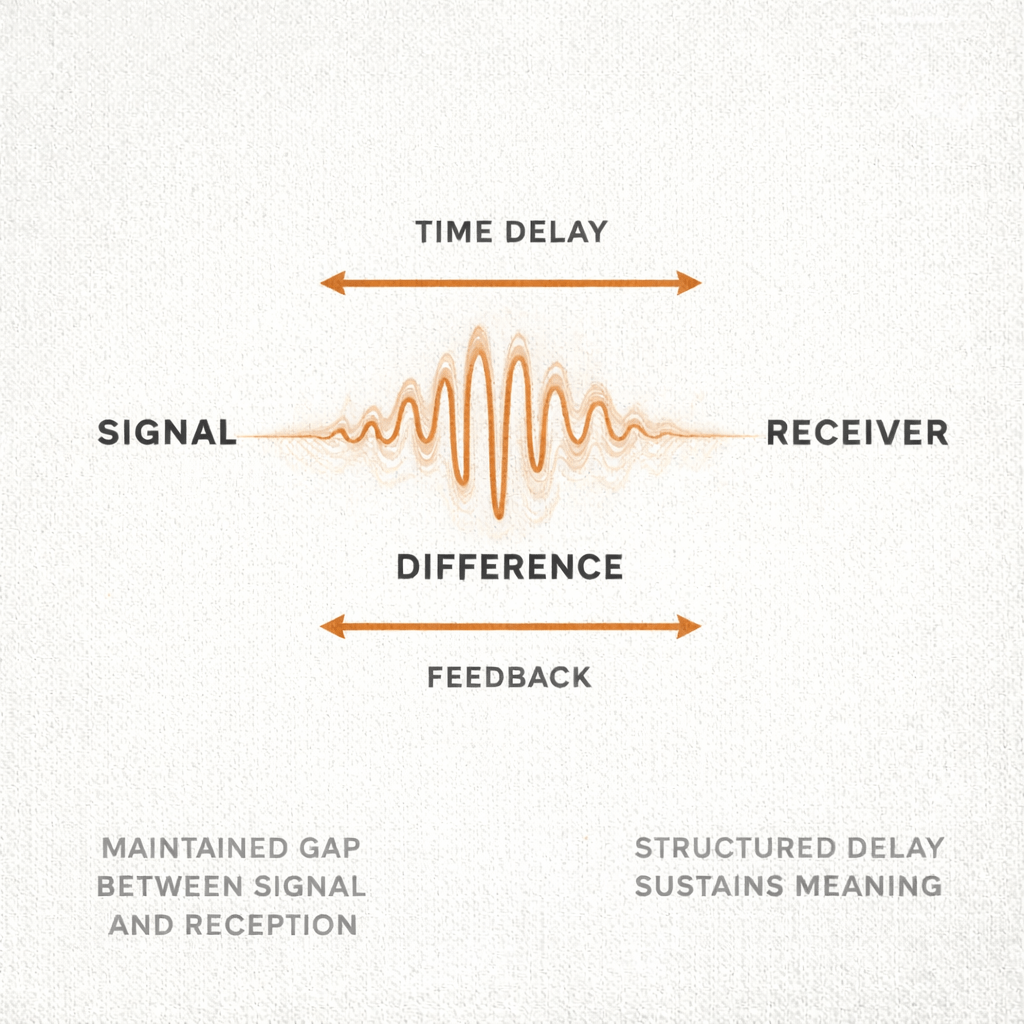
This essay advances a limited but precise claim: meaning in communicative systems depends on structured delay, and that delay is constitutive of causal relations rather than incidental to them. Where there is a point of emission and a point of reception, the signal that passes between them is not merely a connector. It participates in […]

Categories
language

Symbolic Traffic

Language is a game in which winning, or apparent success, is characterised, celebrated, and sustained by the relational value of tokens within it. What actually wins is the communication system itself. Human projects, without exception, are functions of belief within language, of language. Success is the generation of more language. Wealth, politics, and sociocultural dominance […]

Categories
cybernetics

The Structure of Absence: How What Is Missing Holds Systems Together

When people speak of nothing, they usually mean emptiness: no matter, no signal, no information. Yet absence is never encountered in isolation. Something is absent only in relation to an organisation for which it could have made a difference. Absence is not an object or an empty region waiting to be filled. It is the […]