Categories
communication

Maintenance Mode

Modern systems do not fail for lack of intelligence; they fail because intelligence cannot be sustained inside them. What disrupts institutional self-reproduction is neutralised, not because it is wrong, but because it shortens the cycle. That is the sustainability problem. A civilisation that cannot maintain its own capacity for understanding cannot respond coherently to anything […]

Categories
cybernetics

The Sociocognitive Dangers of AI

We are building machines that can talk, draft, diagnose, summarise, and imitate. Each month the interface becomes smoother; each week the latency shrinks. The friction that once shaped our thinking — the tiny deferrals through which thought organises itself — is being polished away. It feels like progress because the response arrives quickly and looks […]

Categories
cybernetics

Limited Language Models

In recent years, large language models have moved along a gradient from research artefacts into everyday infrastructure—search, email, design tools, call centres, legal drafting, medical triage. They operate by predicting the next token in a sequence, trained on vast corpora of text and code. Their fluency comes from compression, not comprehension. They do not possess […]

Categories
communication

Writing Without AI

It is a dying practise. Even as automation bludgeons narrative salience and nuance into the cognitively and culturally low-functioning relational slurry that it has now become, our thought patterns and socioeconomic reflexes adapt and align along with it. Try writing without AI. Feel the difference. That is natural intelligence. That is life.

Categories
cybernetics

General Intelligence

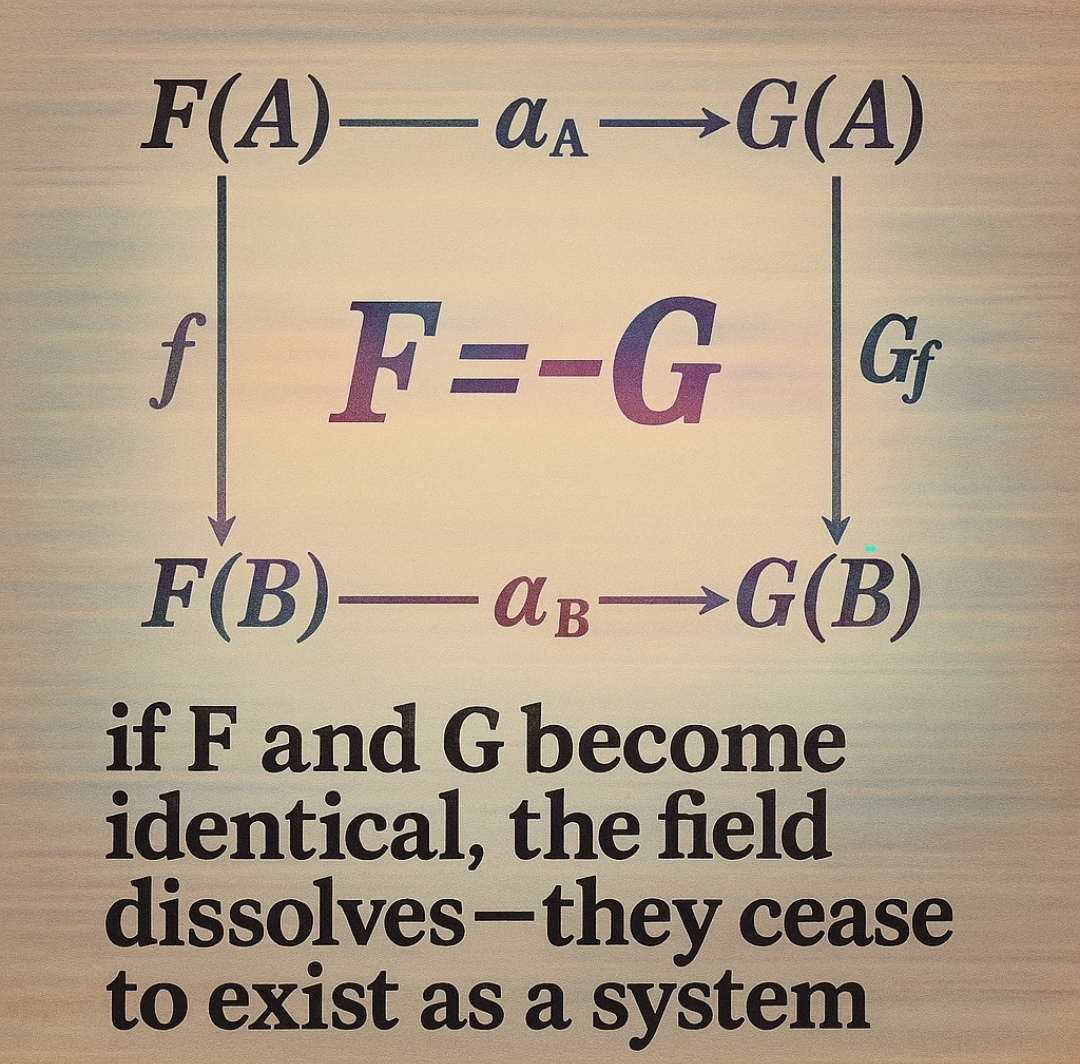
Imagine F and G as two interdependent operations—each defining the other through difference. F acts as a generator: it constructs hypotheses, projections, or internal states. G acts as a comparator: it evaluates, reflects, and reintroduces the outcomes of F back into the system. The diagram’s symmetry, where F = − G, indicates an inversion rather […]

Categories
cybernetics

Phase Modulation and the Evolutionary Field

Biological evolution can be read not as a ladder of material refinement but as a synchronisation phenomenon—a system exhibiting Kuramoto-like synchronisation (1984), a mathematical model of how independent oscillators—like fireflies or human hearts—fall into rhythm. Each organism, gene, or mind acts as an oscillator, sustaining an internal rhythm through cycles of metabolism, reproduction, or thought. […]

Categories
Complexity

Tylenol

What if autism isn’t a glitch in the human code but a pattern in the larger field, a ripple of constructive difference emerging where things are becoming too uniform? Intelligence may not be a sealed package behind our eyes but a network effect of bodies, environments, and signals, a distributed resonance rather than a solitary […]

Categories
Philosophy

Climate Change and the Logic of Holism

Climate change resists treatment as a set of isolated variables. It is not reducible to emissions inventories, technological substitutions, or regional agreements. It is a whole system phenomenon, where every action is bound into the larger field, and every tension is a projection of the system itself. The key property is not in the fragments […]

Categories
cybernetics

Technical Insecurity

Because mathematics is infinite, the field of cybersecurity can never be truly closed. The space of vulnerabilities is unbounded, each patch or solution only ever an approximation against the open horizon of possible attacks. Risk is permanent, not as a flaw but as a structural consequence: a system that protects itself must also endlessly expose […]

Categories
Philosophy

Expertise

Our universities are not producing experts or competency, but inasmuch as they are—and where they are—it exists only as an outlier within the great goo of median self-replication to which hierarchical bureaucracy is naturally attracted. The institutional frame does not optimise for insight but for the recursive preservation of itself, absorbing deviation back into the […]

Categories
cybernetics

Extreme Economics

Extreme economic doctrines—whether right or left—are structural performances, temporary galvanizations around dysfunction. They flare precisely because they replicate the fractures that sustain them. What appears as crisis-management is, in fact, a choreography of failure made durable. The intentional destruction of poverty is not an error of policy but a condition of possibility for wealth at […]

Categories
Philosophy

Intelligence: How, not What

Intelligence is too often mistaken for the sum of its parts, as if knowledge were a pile of isolated facts—points that can be counted, catalogued, and stacked. This is the mechanistic view: determinism reduced to inventory. What gets overlooked in that framing is the field—the structure of relations, the gradients of difference, the resonance through […]