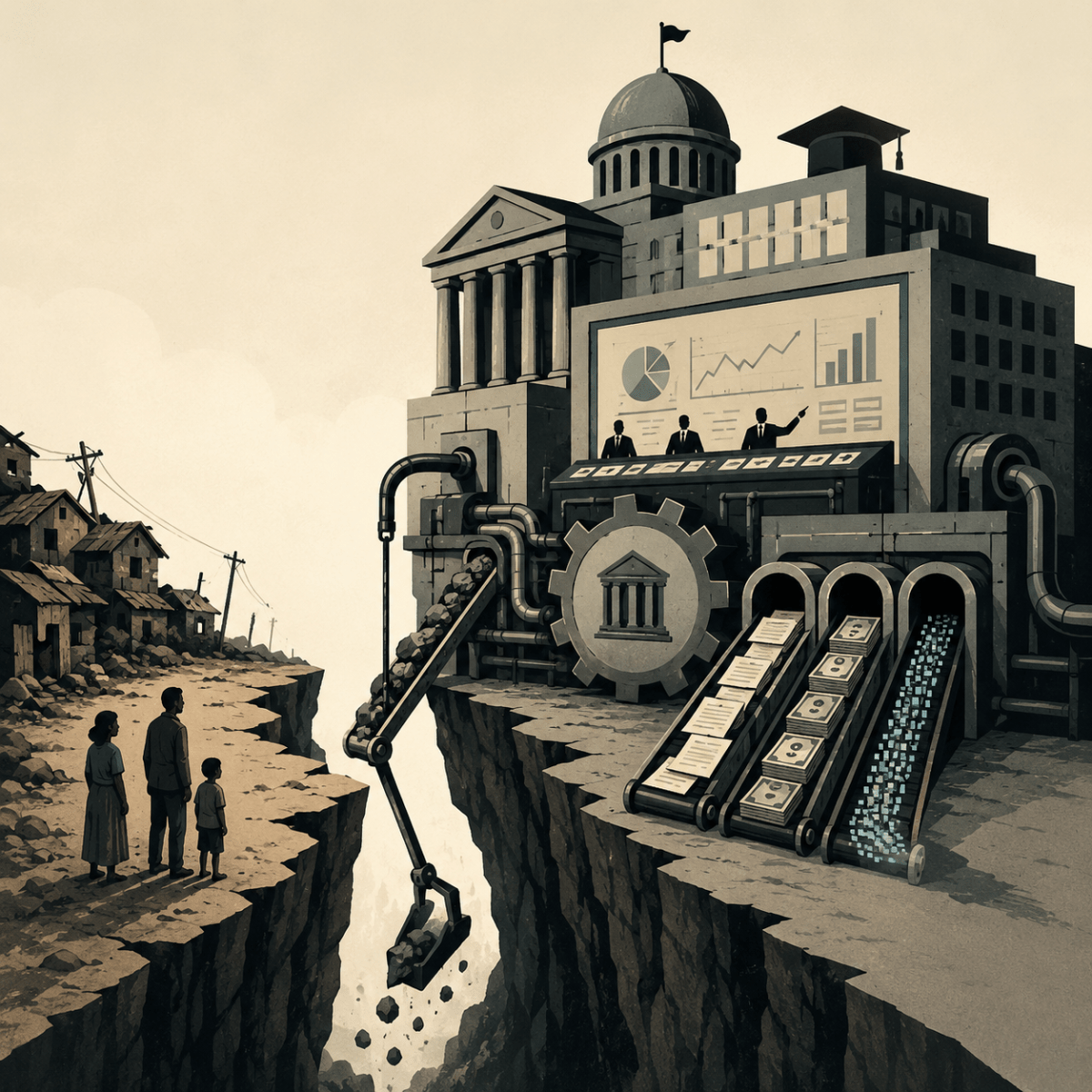
Institutions rarely fail because they cannot recognise problems. They fail because recognising problems is not the same as escaping the conditions that reproduce them.
Categories
how complex institutions preserve failure
- Post author By G
- Post date Jul 31, 2026
- No Comments on how complex institutions preserve failure
- Tags adaptive-systems, aptitude filter, Artificial Intelligence, bureaucracy, cognitive attractor, communication theory, communicative systems, complex systems, cybernetics, entropy, ethical integrity, feedback loops, governance, government accountability, government failure, information systems, institutional failure, institutional inertia, institutional reproduction, intelligence test, logical orbit, machine intelligence, machine-readable art, market signals, media ecology, media systems, orbit frame, organised difference, path dependence, pattern recognition, persistence theorem, policy failure, political communication, political institutions, possibility space, probability, public administration, public opinion, recursive communication, recursive decoding, recursive systems, regulatory systems, relational ontology, self-describing systems, self-reference, semantic compression, social systems, state capacity, structural corruption, structural reasoning, symbolic encoding, systemic persistence, systemic risk, systems theory, visual ontology