Categories
cybernetics

The Geometry of the Unconscious

The unconscious is not a hidden chamber beneath awareness, nor a secondary mind running in parallel. It is the emergent interior of dynamical, adaptive, relational complexity itself. It is what complex systems feel like from the inside. Any system capable of learning, anticipation, coordination, and self-regulation must generate internal structure that cannot be fully present […]

Categories
cybernetics

After Trump

If the United States survives Trump, there is a genuine possibility of reconstruction, but only because damage exposes the relationships that mattered and brings hidden dependencies into the open, revealing how the system was actually held together. The damage being inflicted is real and severe, economic and political at once. Disruption to institutions, markets, and […]

Categories
cybernetics

Productive Misanthropy

Service delivery systems must model the environments they act within. This is unavoidable. Eligibility rules, risk categories, performance metrics, and compliance frameworks are all abstractions that allow action under constraint. The model is not the world. It is an interface that reduces complexity to something administrable. Over time, however, the interface acquires weight. The abstraction […]

Categories
cybernetics

On the Structural Limits of Political Language

Victor Klemperer’s The Language of the Third Reich was written under conditions that were materially, professionally, and existentially constraining. As a Jewish academic in Nazi Germany, he was excluded from public life, subject to surveillance, and deprived of institutional protection. The book did not emerge as a theoretical project but as a record: observations accumulated […]

Categories
cybernetics

Field Logic and Semiotics

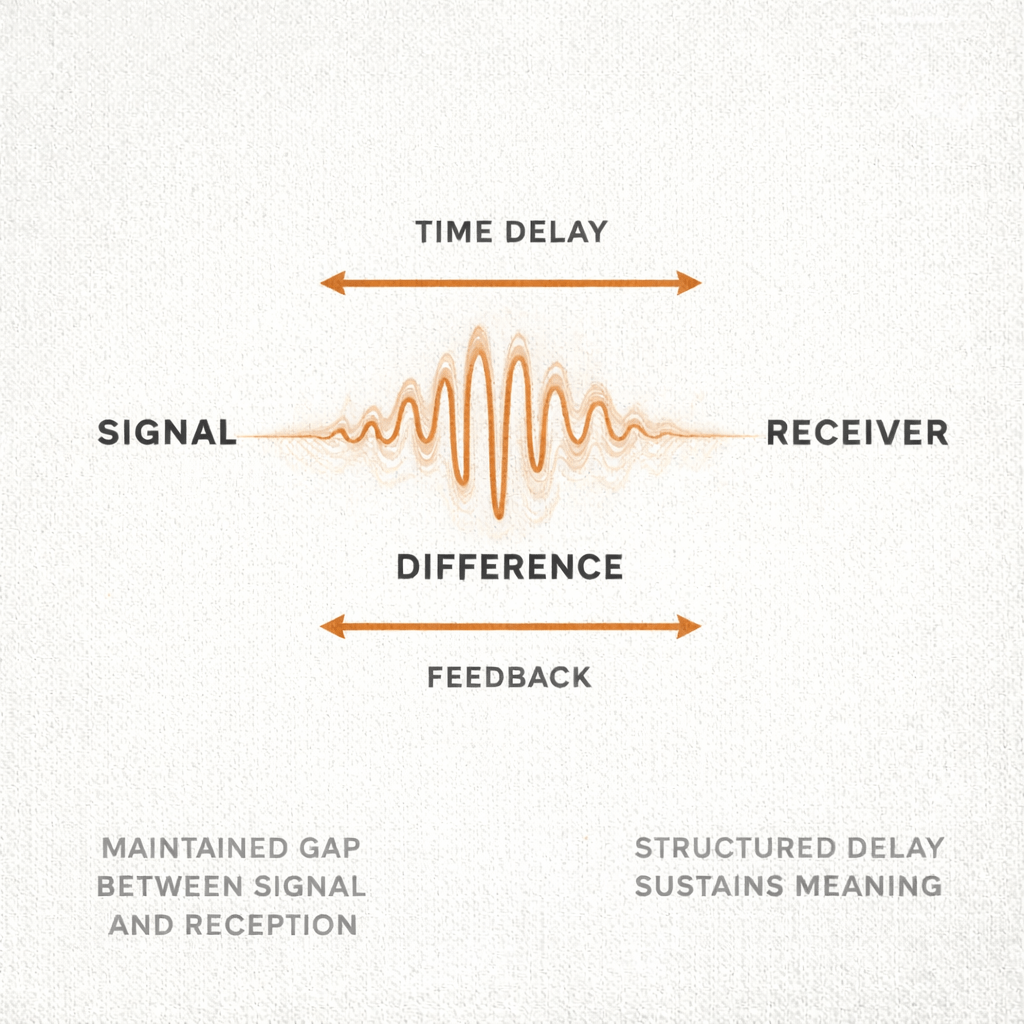
This essay advances a limited but precise claim: meaning in communicative systems depends on structured delay, and that delay is constitutive of causal relations rather than incidental to them. Where there is a point of emission and a point of reception, the signal that passes between them is not merely a connector. It participates in […]

Categories
language

Symbolic Traffic

Language is a game in which winning, or apparent success, is characterised, celebrated, and sustained by the relational value of tokens within it. What actually wins is the communication system itself. Human projects, without exception, are functions of belief within language, of language. Success is the generation of more language. Wealth, politics, and sociocultural dominance […]

Categories
Psychology

Vanishing Point: Self-ish

The self is commonly understood as something one has: a centre of experience, a point of view, a continuous “me” that persists through time. Psychological models tend to formalise this intuition by treating the self as a representational structure—narrative continuity, minimal experiential core, or predictive model—through which coherence can be maintained. This move is not […]

Categories
Philosophy

Uncool, Cybernetics School…

What begins as an act of response—a mutation, a thought, a tool—is not designed to last. It emerges, briefly optimal in a changing landscape, then fades or fragments. But sometimes, the solution doesn’t end when the problem is gone. Sometimes the solution learns to survive. It begins to reinforce itself, not because it’s still needed, […]

Categories
Complexity

Self-Organising Criticality in Brains, Battles and Universes

The notion (articulated in the video) that the homeostatic process by which quasicriticality is maintained in the brain may have an essentially cybernetic explanation. In Jeff Hawkins’ “A Thousand Brains” he references neurophysiologist Vernon Mountcastle’s belief in the existence of an underlying (as unifying) organisational principle in the brain. I wouldn’t be at all surprised […]

Categories
Alien Anthropology Philosophy

Playing the Long-Game of Human Civilisation

The catastrophic entropy of a currently most-probable future is not the only available solution in the possibility-space of all emergent and adaptive human planetary civilisations.

Categories
Philosophy

Cultivating Innovation

Sociological, psychological and economic systems are poorly optimised to cultivate or acknowledge the forms of innovation and creative thinking that their existence in the world depends upon.