Categories
cybernetics

Populism

What we are dealing with is not primarily a moral or semantic crisis, even though it is experienced that way. Planetary-scale communication systems behave like physical systems with dense feedback and high throughput: they develop statistical biases toward states that reproduce the conditions of their own continuation. These systems have ontic reality—that is, they are […]

Categories
cybernetics

Meaning: Uncertainty Disco

Meaning does not exist in words, ideas, or intentions taken in isolation. It arises from a relational system in which elements acquire significance only through their differences from one another over time. Words are defined by other words; references defer to further references; interpretation always lags expression. That lag is not an accident or a […]

Categories
cybernetics

Service Delivery: Delay Is the Control Parameter

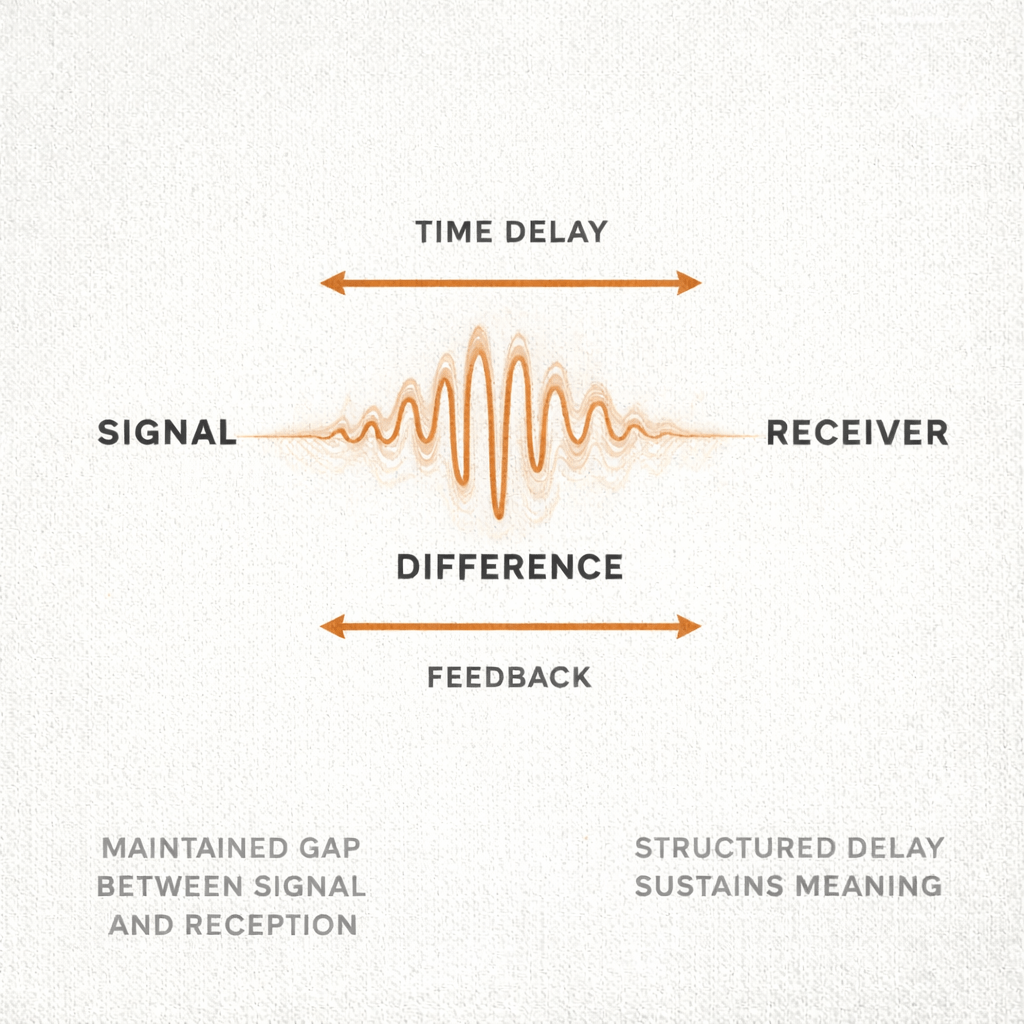
Executive summary Delay is not a flaw to be engineered away. It is the control parameter that sets a system’s operating frequency. Most complex organisational and institutional service delivery systems tend to fail when their timing is misaligned with the realities they are intended to regulate. That misalignment is rarely visible as a single “slow […]

Categories
Philosophy

Stultification Tsunami

The problem is not stupidity. Stupid ideas, taken individually, are manageable. They can be argued with, filtered, contextualised, ignored, or simply outgrown. Human cultures have always contained vast quantities of nonsense and survived quite well. That is not what is new. What is new is scale. A tsunami is not dangerous because each molecule of […]

Categories
cybernetics

Governance as Harmonic Coordination

Governance can be understood as the management of phase relations within an ensemble, not the enforcement of uniform behaviour. In any governed system—social, institutional, technical, or ecological—coherence does not arise from fixing positions or eliminating difference. It arises from partial synchronisation: agents align enough to act collectively while remaining out of phase enough to retain […]

Categories
Philosophy

[01] Disinformation Dynamics: Unified Framework

Series preamble: this series of documents is an educated guess. I study complexity, communication, and culture. The underlying harmonic structure should be evident to anyone with a passing familiarity with physics, mathematics, or logic. Manifold dynamics provide a topological bridge to and through communication systems, and in some sense are those systems. Disinformation functions here […]

Categories
Philosophy

[02] Disinformation Dynamics: Recursive Harmonics

2.1 Coherence as a Function of Recursion Every communication system is recursive. It consists of elements that transmit signals influencing their own subsequent states. This self-reference produces coherence. A message gains meaning not because it exists but because it is repeated, referenced, and reinterpreted. Without recursion, meaning is static. With recursion, meaning becomes dynamic and […]

Categories
Philosophy

[03] Disinformation Dynamics: Interdiction Operations

3.1 Measurement Philosophy Measurement in recursive harmonic systems does not isolate variables; it captures relationships. Every observation modifies what is observed, because communication systems are reflexive. Therefore, measurement itself must be designed as participation in the field—an act of modulation that respects feedback dynamics. The goal is not to determine truth but to detect phase […]

Categories
cybernetics

The Edge of Chaos in Conflict and Communication

Language and (other) communications technologies are built around and positively amplify the signals of difference by and through which human beings define, understand and share or record their experience of the world. The abbreviated macrostates of variously competitive self-definitions emerge and converge in ways that recursively drive the adaptive self-propagation of the communication systems and technologies that embody their primary transmission […]