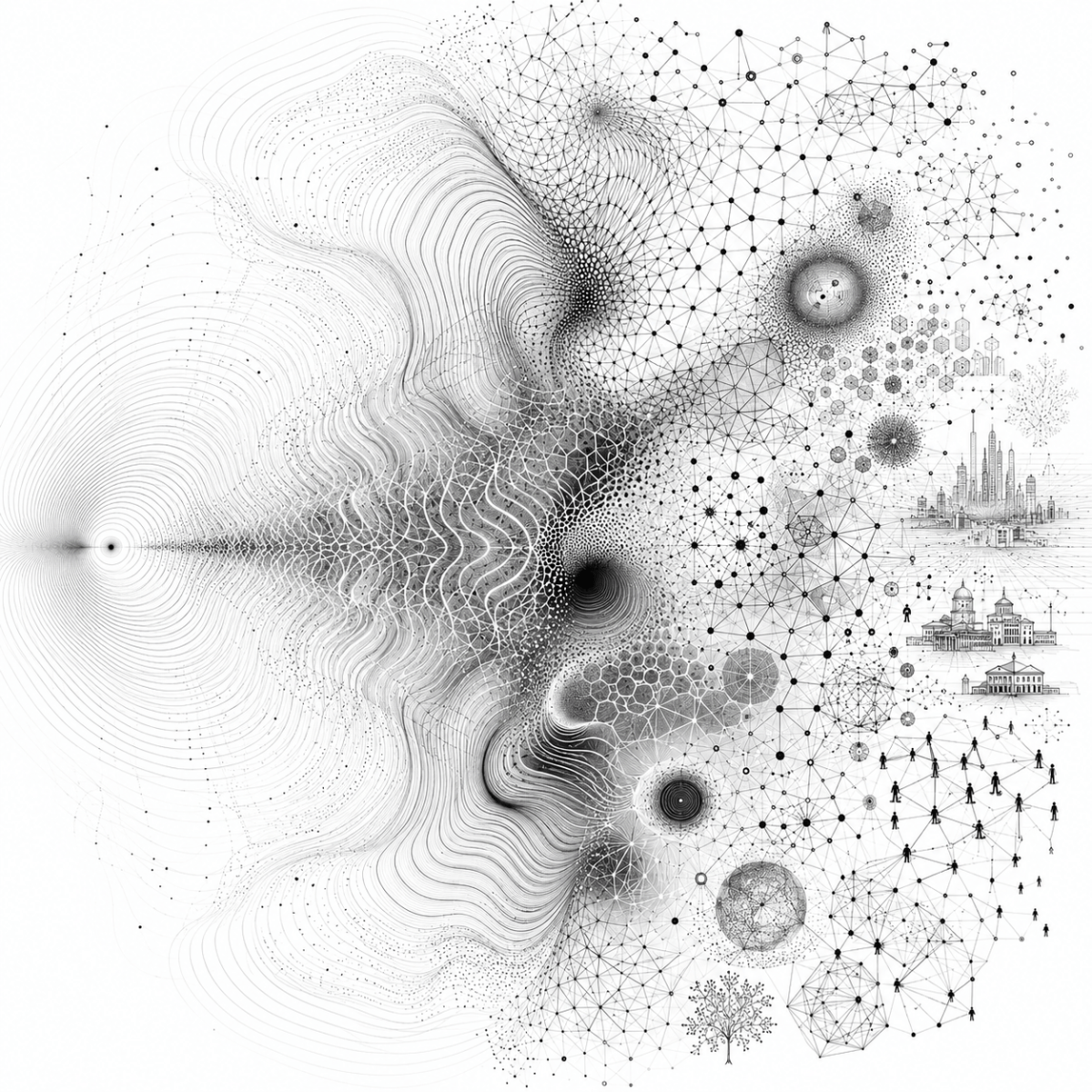
Influence is the capacity of a communicative form to alter the probability distribution of future communication.
The strangest thing about meaning is that it does not arise from certainty but from its absence. Language works because something always escapes complete description. What remains unsaid is not a failure of communication. It is the condition that makes communication possible.
In communicative systems, coherence and meaning are not imposed upon rhythm—they are rhythm. Spectral coupling describes how oscillations across communicative fields synchronise, producing the shared periodicities that we experience as understanding. Patterns of delay, resonance, and amplitude alignment constitute the grammar beneath language—the field’s temporal architecture of sense. To communicate is to phase-lock; to mean […]
Technologically mediated communication intensifies what language has always done: it isolates, divides, and distances us from one another, and from ourselves, as a necessary precondition for meaningful communicative experience to arise at all. Given the nature of the world, I carry a quiet regret at not having known more people more fully, even while understanding […]
The rise of rigid ideology is a reciprocal function of the simplicity of the language with which it embellishes itself. This is not a moral judgement, nor an apologetic for autocracy, but a statistical inevitability: simplicity wins because simplicity persists. Such narratives are not the only dynamics at work, but they gain disproportionate attention. Words […]
I dare say that wherever humanity does or does not find itself in regards to hyper-accelerating tech ological metamorphosis, this destination (or waypoint) will only ever be the most probable as manifest constellation of all possible artefacts, entities and systems in the world. I study holism. Ironically, you come to see it everywhere.
Under some definition of artificial intelligence, generative complexity is remarkable and for at least two primary reasons. First: to use these interfaces to inordinately high-dimensional information systems is always and already to concede some marginal threshold of control. You just never know what the model outputs will be and this represents both the technology’s strength […]
I am quite interested in the ways in which a normative gamification of language (in wordle, crosswords, quizzes, tests and other educational, institutional, political or ideological taxonomies) reflects and reinforces the essentially probabilistic information signal that inflects all linguistic statements, descriptions and assertions of fact with significance. The words, concepts and downstream grammatical or cultural […]
The role of language in cultural and political systems of belief is such that geographic tropes are anchors that provide internal narrative self-validation to such systems and their inhabitants. It doesn’t mean their assertions of territorial impropriety are valid, merely that such adversarial gambits are the perennially ascendant low-hanging fruit of belligerent nationalist pathologies everywhere […]
There is a relationship between speech and cognition. There is also a relationship between written language and intelligibility. The longer and more convoluted a sentence, the harder it becomes to understand. The harder the sentence is to understand, the less likely it will self-replicate through artefacts, entities and systems of communication. What this means is […]
All civilisation is built upon the toss of a coin.
Information is a quantification of the difference between the current state of a system and its most probable state.