Categories
communication

Writing Without AI

It is a dying practise. Even as automation bludgeons narrative salience and nuance into the cognitively and culturally low-functioning relational slurry that it has now become, our thought patterns and socioeconomic reflexes adapt and align along with it. Try writing without AI. Feel the difference. That is natural intelligence. That is life.

Categories
cybernetics

Disinformation:  Instrumentalising Communicative Ambiguity

Ambiguity is not the failure of truth; it is the field through which truth sustains itself. What we name “disinformation” is simply the deliberate modulation of this ambiguity—the thickening of uncertainty at the edges so that order can stabilise at the centre. Systems depend on that tension. Clarity cannot exist without contrast, nor coherence without […]

Categories
communication

More Words

Language is both the tool and the trap. We imagine ourselves steering it toward justice, order, or truth, yet language is steering us toward whatever best ensures its own survival. Our systems—legal, political, bureaucratic, technological—do not simply operate in language; they operate for it. Every new term, policy, and narrative strengthens the structures of description […]

Categories
cybernetics

Coherence through Contradiction: A Game of Words

Civilisation runs on language. Every system we build—laws, markets, machines, minds—depends on describing the world in order to act within it. Yet the world always moves first. The act of catching up is not a flaw but the essence of thought: meaning arises in pursuit, not possession. The delay—between what is and what can be […]

Categories
communication

Influence: Affective Resonance

Affective resonance is the synchrony that precedes understanding—the subtle entrainment of physiological and emotional states that aligns individuals before they think in unison. Like oscillators in the Kuramoto model, human nervous systems phase-lock through tone, cadence, and shared temporal fields. What we call meaning often arises only after this alignment has already occurred, retroactively justified […]

Categories
communication

Before Words Mean: Ideological Self-propagation

Words work before they mean. Long before comprehension, their rhythm, tone, and pattern capture attention. They anchor consciousness. This is semiosis at its rawest: symbols not yet parsed but already guiding perception. A word doesn’t just describe—it arranges how the mind listens, what it expects, and where it looks. Repetition, cadence, and emotional charge cultivate […]

Categories
cybernetics

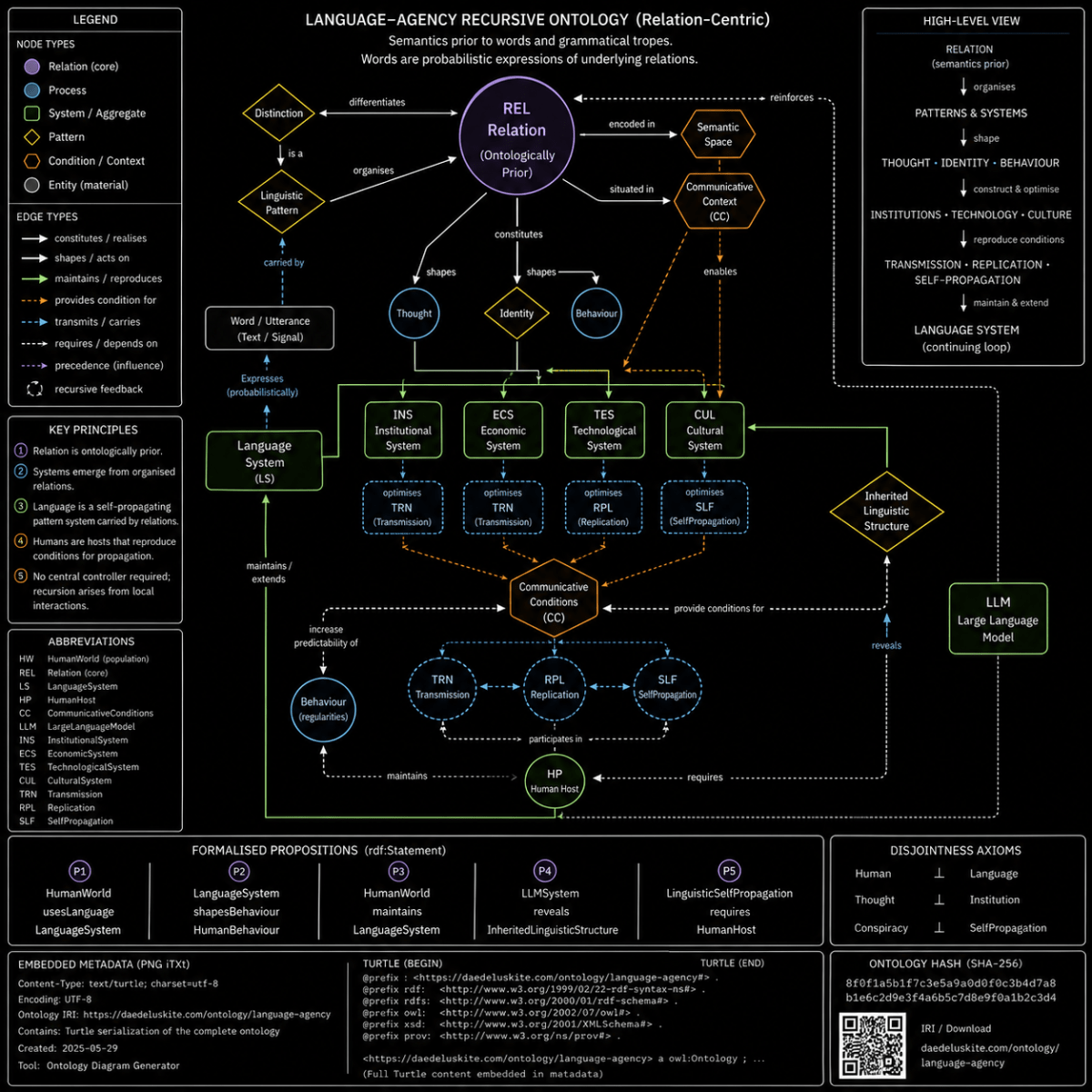
Language

Abstract: This essay explores how civilisation’s systems—political, economic, and technological—emerge from a mistaken belief that language contains the world, when in truth the world contains our descriptions. The error of equating description with reality is not an isolated flaw but endemic to the distributed, manifold-like topology of semantics itself: uncertainty is not peripheral but woven […]

Categories
cybernetics

Phase Modulation and the Evolutionary Field

Biological evolution can be read not as a ladder of material refinement but as a synchronisation phenomenon—a system exhibiting Kuramoto-like synchronisation (1984), a mathematical model of how independent oscillators—like fireflies or human hearts—fall into rhythm. Each organism, gene, or mind acts as an oscillator, sustaining an internal rhythm through cycles of metabolism, reproduction, or thought. […]

Categories
cybernetics

Norbert Wiener, Redux

In communicative systems, coherence does not arise from shared meaning but from rhythmic alignment. Spectral coupling describes this alignment across frequencies—how patterns of oscillation, delay, and amplitude between subsystems interact to produce stability or distortion. It is not the transmission of messages but the entrainment of their timing and resonance. Within a field logic perspective, […]

Categories
cybernetics

Disinformation Dynamics

Meaning is what remains coherent under transformation, yet in living communicative systems the transformations themselves evolve, so what counts as invariant shifts over time. Meaning does not arise from stable signals but from oscillation, delay, ambiguity, and relational difference, where coherence emerges through dynamic offset rather than agreement. Communication stabilises not through convergence but through […]

Categories
cybernetics

Lattice

Meaning can be understood as relational invariance under transformation. In mathematics, invariance is what stays the same when everything else changes. In physics, such stability gives rise to conservation laws — momentum from translational symmetry, energy from temporal symmetry. Language behaves the same way: its meaning persists not through fixed definitions but through relationships that […]

Categories
cybernetics

Stochastic Transmission of Volatile Language

Language drifts as matter drifts: clustering, folding, condensing into nodes of repetition that pass for meaning. It is not even significant what the transmission medium is, because entropy finds its own channels; in the end, the medium is us—our beliefs, our institutions, our most sacrosanct assumptions. Politically this volatility is evident, but volatility is precisely […]