Categories
Philosophy

self

The self never settles because the world never settles. Your body changes. Neural chemistry fluctuates. Memory edits itself. Relationships move. Context rearranges. Words drift. Culture turns. New facts arrive, old certainties decay, and the feedback never stops. So the self is not rewritten because it is faulty, but because it is embedded in conditions that […]

Categories
Philosophy

At the Edge of Meaning

Nietzsche once suggested that metaphysics is about as useful to the struggles and uncertainties of embodied life as would be knowledge of the chemical composition of water to a boatman facing a storm. The force of the remark is not hostility to thought but a boundary placed around it. In conditions of living and existential […]

Categories
cybernetics

Institutional Machinery of Self-Description

Large institutional systems do not merely maintain narratives about what they are doing or why they are doing it. They stabilise meta-procedures: how statements are produced, validated, circulated, and sanctioned, because at scale the reasons matter less than the repeatability of the process. These methods become the true object of protection because they allow coordination […]

Categories
cybernetics

Meaning: Uncertainty Disco

Meaning does not exist in words, ideas, or intentions taken in isolation. It arises from a relational system in which elements acquire significance only through their differences from one another over time. Words are defined by other words; references defer to further references; interpretation always lags expression. That lag is not an accident or a […]

Categories
cybernetics

Organisational Holism

Field Integration Protocol — Metaphysical Complexity in Organisational Strategy 1. Orientation Every organisation lives within a field larger than itself—an ecology of signal and response. Leadership is not command but participation in coherence. Institutions, like thought, are recursive epistemic fields. They translate the world into language, law, and data. When translation hardens into doctrine, systems […]

Categories
cybernetics

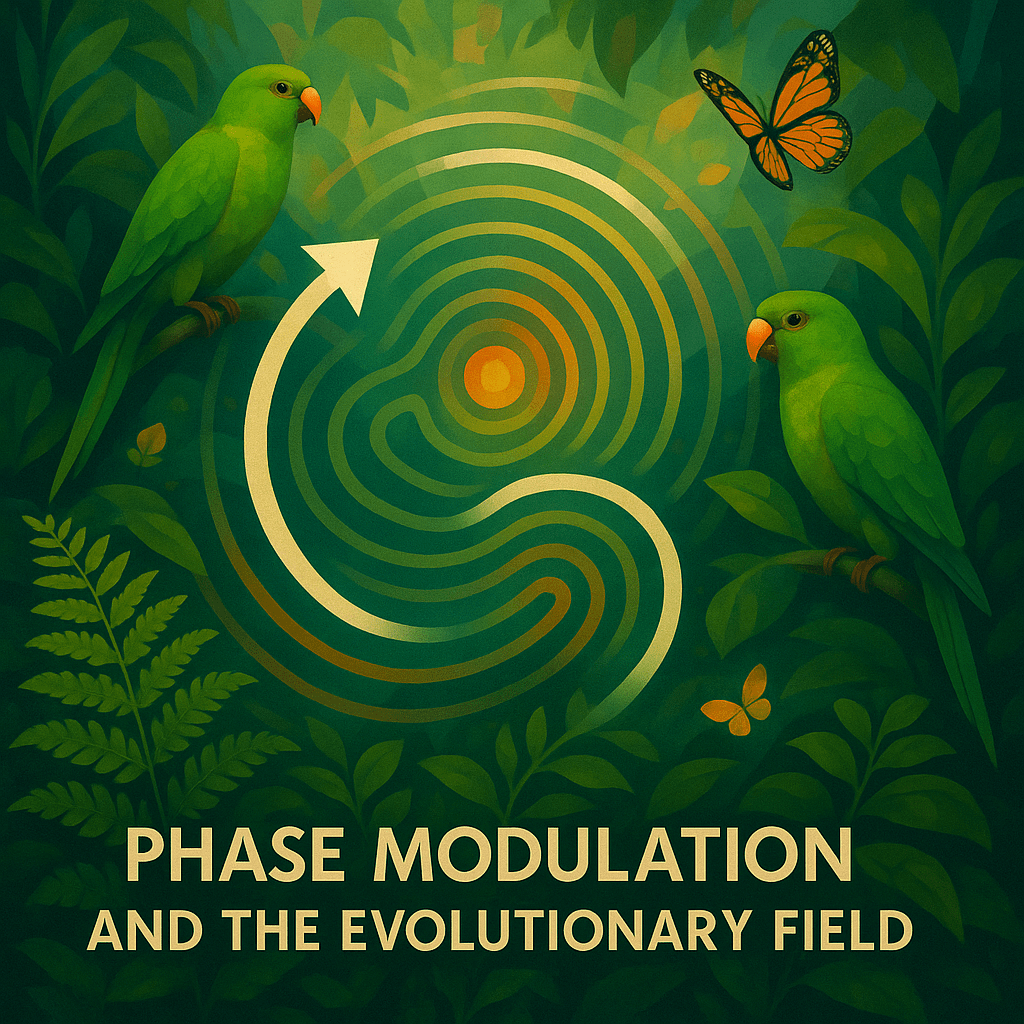
Phase Modulation and the Evolutionary Field

Biological evolution can be read not as a ladder of material refinement but as a synchronisation phenomenon—a system exhibiting Kuramoto-like synchronisation (1984), a mathematical model of how independent oscillators—like fireflies or human hearts—fall into rhythm. Each organism, gene, or mind acts as an oscillator, sustaining an internal rhythm through cycles of metabolism, reproduction, or thought. […]

Categories
cybernetics

The Necessary Distance: Why Perfect Synchrony Destroys Identity

Imagine a crowd of fireflies. Each blinks on its own rhythm, yet over time many begin to flash together. The spectacle is mesmerizing, but beneath the beauty lies a puzzle: if they all blink at precisely the same instant, the individuality of each vanishes into a single, undifferentiated pulse. This isn’t just a curiosity of […]

Categories
cybernetics

OODA Budo

Helmuth von Moltke the Elder, writing in the 19th century, observed that no plan of operations could be expected to survive first contact with the enemy. His insight was not that planning was useless, but that the continuity of command intent required adaptation under conditions of uncertainty. Strategy, as Moltke framed it, could not be […]

Categories
cybernetics

When Technology Owns Our Experience More Than We Do

Technology inserts itself into experience by mediating, amplifying, and normalising it. What once belonged to us in the raw, unfiltered sense is now shaped by templates and signals recycled from past data points. The repetition of what is measurable and recognisable makes certain experiences feel inevitable, while sidelining the nuance that refuses codification. This isn’t […]

Categories
cybernetics

On Meta-Stability: Why Things Have to Break

We keep lying to ourselves about stability. The polite story is that systems aim for balance, that institutions exist to keep things steady, that culture and politics and technology are here to make life manageable. But none of that is quite true. Things don’t hold together because they are stable in any simple sense. They […]

Categories
cybernetics

Recursive Tension: Orbit Frame, Logical Orbit, and the Viability of Communication, Culture, and Ecological Systems

Abstract This paper advances a cybernetic account of complex adaptive systems in which coherence is sustained by unresolved tension rather than equilibrium. The orbit frame is introduced as a relational model that represents systems as networks of elastic constraints across gaps that never fully close. Logical orbit is defined as the recursive dynamical process that […]

Categories
cybernetics

Entropic Respiration

For a system to persistently self-sustain, it has to negotiate and/or “exhale” its own waste products as entropy. Generating waste that is reusable by something or someone else is all but ubiquitous in biology. Human systems (and consequences, in a scaled, industrial and technological sense) might be uniquely distinguished by the volume, diversity and cadence […]