Categories
cybernetics

Limited Language Models

In recent years, large language models have moved along a gradient from research artefacts into everyday infrastructure—search, email, design tools, call centres, legal drafting, medical triage. They operate by predicting the next token in a sequence, trained on vast corpora of text and code. Their fluency comes from compression, not comprehension. They do not possess […]

Categories
cybernetics

Technical Debt

The more precisely a technological system is engineered—its algorithms finely tuned, its processes deeply automated, its data flows tightly orchestrated—the more space is created for chaotic ambiguity to hide in the seams. In social media, for instance, the apparatus of engagement-metrics, feed-ranking, and viral amplification claim clarity and intent, yet they spawn unpredictable collective behaviour: […]

Categories
cybernetics

Drift

Autonomous technological systems now routinely adjust themselves through internal feedback: machine-learning pipelines that retrain on their own outputs, trading algorithms that react to price movements they partly create, recommendation systems that optimise engagement based on the behaviours they induce. Human input still exists, but it is sampled as data, not held as authority. Governance happens […]

Categories
cybernetics

The Physics of Nothing: How Missing Information Holds Systems Together

When people speak of nothing, they usually mean absence. No matter. No signal. No data. But in complex systems, absence is rarely empty. What is missing often functions as constraint, and that constraint is frequently what makes coherence possible. Across logic, computation, physics, cognition, and social organisation, systems do not persist because they contain everything […]

Categories
cybernetics

Manichaean  Modulation

Systems don’t hold their shape by conviction. They hold it by habit, cadence, and the slow accretion of tiny decisions that feel neutral while they’re happening. What we call an “economic model” or a “political order” is just a particular tuning of incentives, language, and expectation. Shift the tuning and the whole field reconfigures. The […]

Categories
cybernetics

Mind the Gap: Hidden Disability

Invisible disability exposes a structural mismatch between experience and assessment. Institutions rely on narrow snapshots — fixed criteria, discrete checkboxes, procedural thresholds — to determine what counts as relevant evidence. These frames compress complexity into a form legible to an administrative workflow, but the compression also screens out the fluctuating cognitive load, episodic variation, and […]

Categories
cybernetics Philosophy

Civilisation is Choking on Greed

Civilisation was never meant to run on panic, yet that is the rhythm we’ve drifted into. The public story insists we are building a future, but the machinery underneath tells a different tale — one of shortening time-horizons, defensive accumulation, and a cultural field tuned to performance rather than survival. The great systems of finance, […]

Categories
cybernetics

Recovery

First rule of recovery from a catastrophic medical event: assume nothing from the systems around you. Social, institutional, and community services can offer only a faint outline of psychosocial or emotional support because they understand only a faint outline of themselves — their own roles, goals, and the long tail of unexpected consequences that accompanies […]

Categories
cybernetics

Organisational Holism

Field Integration Protocol — Metaphysical Complexity in Organisational Strategy 1. Orientation Every organisation lives within a field larger than itself—an ecology of signal and response. Leadership is not command but participation in coherence. Institutions, like thought, are recursive epistemic fields. They translate the world into language, law, and data. When translation hardens into doctrine, systems […]

Categories
cybernetics

Disinformation:  Instrumentalising Communicative Ambiguity

Ambiguity is not the failure of truth; it is the field through which truth sustains itself. What we name “disinformation” is simply the deliberate modulation of this ambiguity—the thickening of uncertainty at the edges so that order can stabilise at the centre. Systems depend on that tension. Clarity cannot exist without contrast, nor coherence without […]

Categories
cybernetics

Coherence through Contradiction: A Game of Words

Civilisation runs on language. Every system we build—laws, markets, machines, minds—depends on describing the world in order to act within it. Yet the world always moves first. The act of catching up is not a flaw but the essence of thought: meaning arises in pursuit, not possession. The delay—between what is and what can be […]

Categories
cybernetics

Strategic Immaturity

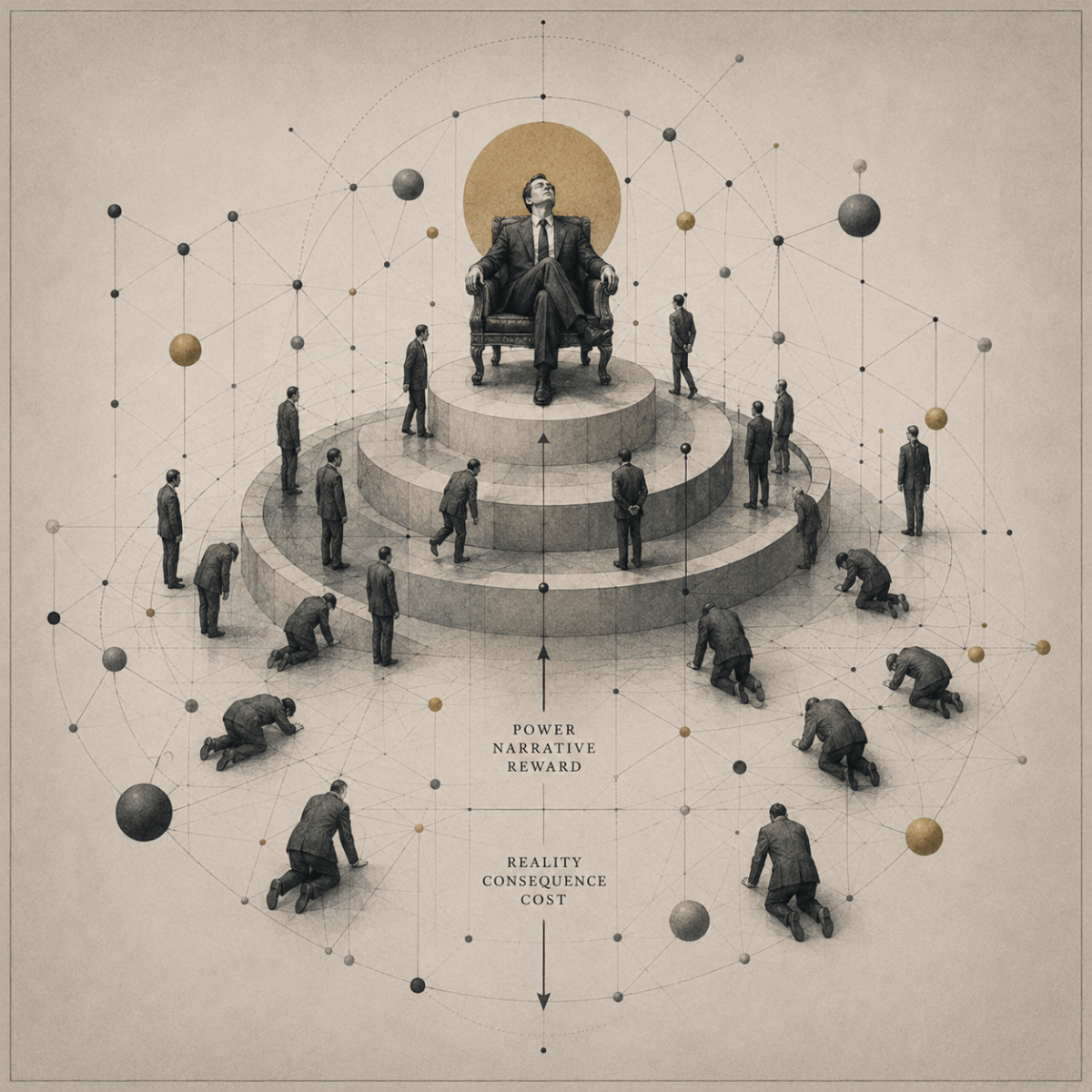
Strategic Immaturity: The belief that gaining control—whether by overthrowing, reforming, or mimicking existing structures—will alter the logic of power itself. In practice, such acts merely replicate and stabilize the very asymmetries they claim to end, reinforcing hierarchy under a new name. Power, once seized, becomes its own justification, not its solution.