Many of the largest problems now confronting technologically advanced societies are not failures of engineering, they are consequences of its success.
Categories
technique, technology, tesseract

Many of the largest problems now confronting technologically advanced societies are not failures of engineering, they are consequences of its success.

Disinformation is not the opposite of information, but one of the ways communication organises uncertainty into meaning. Its deeper structure belongs less to politics than to the philosophical problem of how truth, coherence, and identity emerge at all.

This is how a system built to produce knowledge becomes a system for reproducing the conditions under which its existing knowledge remains authoritative.

The history of technology amplifies existing social, cultural and psychological dynamics around competitive thought and behaviour.

Technology cannot solve itself, because the introspective incompleteness that limits it is a function of the same combinatorial unboundedness that makes it at all possible; spoiler: we humans are similarly and simultaneously bound by identical logic.

Technology promised to save us effort, then quietly reorganised civilisation around the effort required to sustain technology.

Administrative systems fail when they become better at preserving their own procedures than understanding or remediating the human realities those procedures were intended to address.
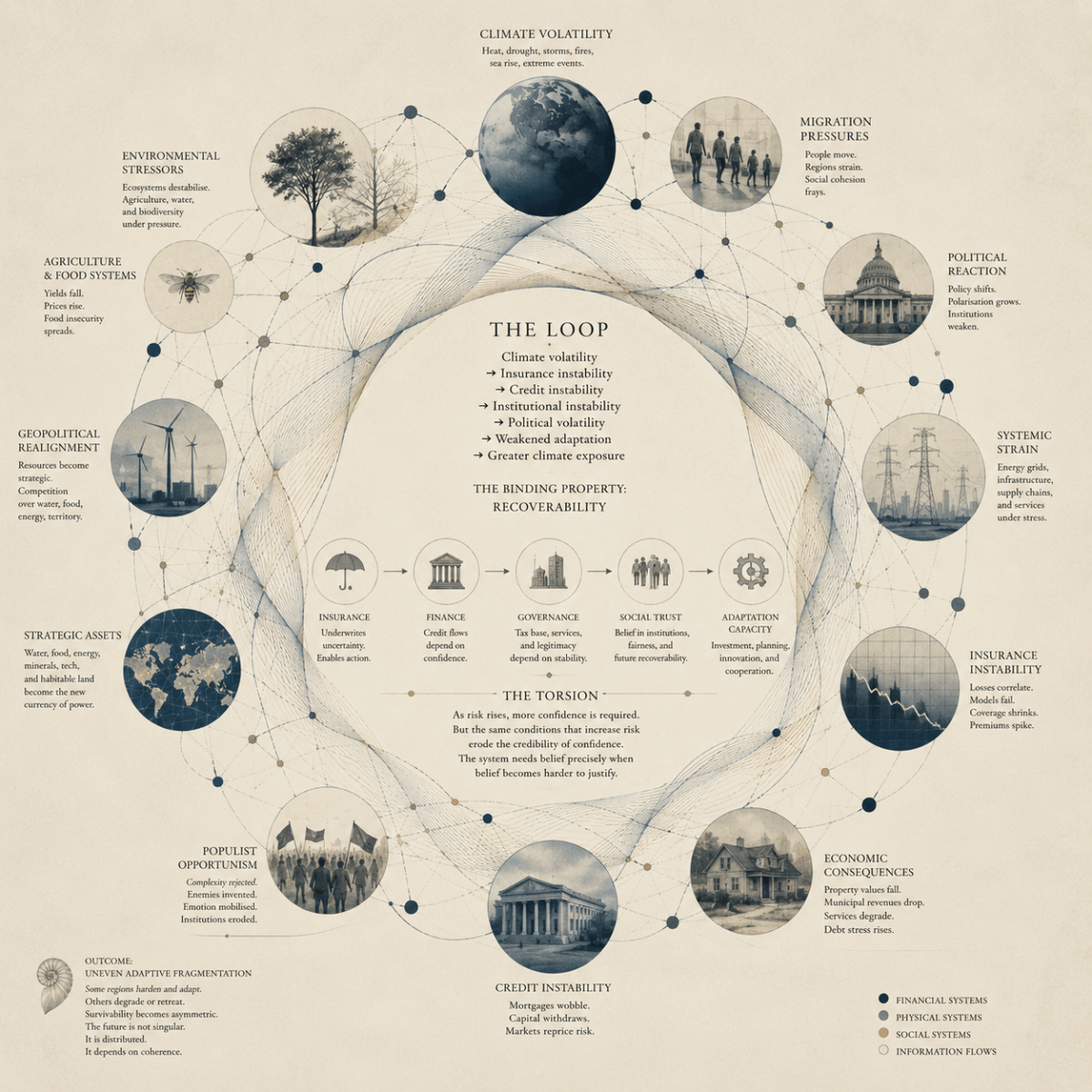
Climate change becomes civilisational risk when insurance can no longer translate catastrophe into recoverable cost.

Malakacene: the long historical moment in which technologically mediated societies stopped selecting primarily for competence, wisdom, restraint, and institutional responsibility, and instead became increasingly vulnerable to the rapid propagation of spectacle, grievance, aggression, narcissism, and performative certainty masquerading as leadership.

A strong current in modern thought still treats things as if they exist first, complete in themselves, and only later enter into relation with other things. The individual. The institution. The nation-state. The market. The technological platform. These are often imagined as discrete objects possessing internal coherence, as though persistence were generated primarily from within […]

A technologically-mediated civilisation has built planetary systems of prediction and control around biological reflexes still calibrated for tribe, threat, status, and symbolic belonging.

It took me a long time and much exasperation to recognise and acknowledge that the first rule of communication systems theory club is: do not tell people about the theory. Not because the theory is secret. Because the theory is ineffective as information. People are not waiting for a better model of the system that […]
Have a WordPress.com account? Log in now.

