Categories
Philosophy

self

The self never settles because the world never settles. Your body changes. Neural chemistry fluctuates. Memory edits itself. Relationships move. Context rearranges. Words drift. Culture turns. New facts arrive, old certainties decay, and the feedback never stops. So the self is not rewritten because it is faulty, but because it is embedded in conditions that […]

Categories
Philosophy

Truth in Language

What is truth. The moment we ask the question, we are already inside language, and everything that follows unfolds from that fact. Truth is not something we approach from outside, as a detached observer might inspect an object. It arises within sequences of tokens, within the games we play with them, within the structures we […]

Categories
Philosophy

Language as Limit

Ludwig Wittgenstein argued that the limits of language are the limits of the world, not as metaphor but as structural fact: what cannot be said cannot be thought in any stable form. Bertrand Russell pursued logical atomism to anchor meaning in precise correspondence, seeking a syntax that could mirror reality without residue. Charles Sanders Peirce […]

Categories
cybernetics

Effective Writing with Language Models

This is not about asking a model to generate ideas for you. It is about placing your own thinking into a responsive medium so it can be worked. You bring partial arguments, intuitions, constraints, and unresolved tensions. The model reflects them back through selective amplification: adjacent phrasings, shifts in emphasis, alternative structures. That amplification makes […]

Categories
Philosophy

At the Edge of Meaning

Nietzsche once suggested that metaphysics is about as useful to the struggles and uncertainties of embodied life as would be knowledge of the chemical composition of water to a boatman facing a storm. The force of the remark is not hostility to thought but a boundary placed around it. In conditions of living and existential […]

Categories
cybernetics

Institutional Machinery of Self-Description

Large institutional systems do not merely maintain narratives about what they are doing or why they are doing it. They stabilise meta-procedures: how statements are produced, validated, circulated, and sanctioned, because at scale the reasons matter less than the repeatability of the process. These methods become the true object of protection because they allow coordination […]

Categories
cybernetics language Philosophy

Living Inside Language

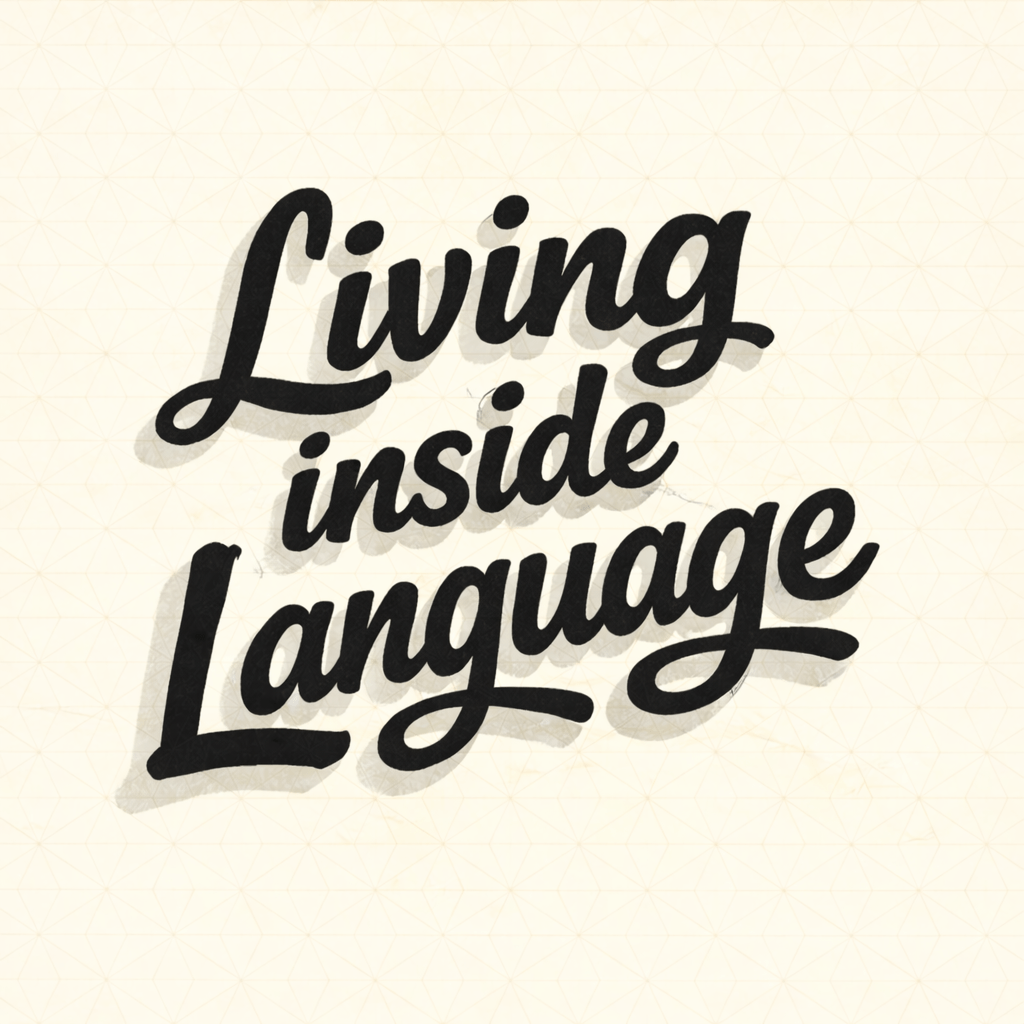
We learn to navigate the world by drawing lines through it. Self and other. Mind and world. Human and machine. These distinctions help us function, the way handrails help us walk down unfamiliar stairs. They stabilise action and expectation. But they are not where reality begins. They are not built into the fabric of existence. […]

Categories
technology

Divided

Technologically mediated communication intensifies what language has always done: it isolates, divides, and distances us from one another, and from ourselves, as a necessary precondition for meaningful communicative experience to arise at all. Given the nature of the world, I carry a quiet regret at not having known more people more fully, even while understanding […]

Categories
Philosophy

Philosophically Attractive

In dynamical systems, trajectories do not simply collapse into rest. They can (and tend to) drift endlessly, circling within strange attractors where motion never repeats yet never escapes. Turbulent fluids, weather patterns, ecological populations, and even networks of neurons exhibit this restless confinement. What seems chaotic is in fact structured wandering, an orbit that sustains […]

Categories
Philosophy

Science and/or Art?

Art is not an externality. Abstractive visualisation is significant for gaining intuitions regarding many relational and topological spaces, networked systems, causal flows and (even, for elaborating) assertions of causality, intent and purpose in mind and/or nature. It is not a matter of art OR science, which as a logical relationship approximates and resolves to some […]

Categories
art

Generative Design

An inexorably rapid turn to generative art indicates a complementary toolkit for creative designers. If it is a technology that doesn’t already exist, I look forward to being able to create, curate and refine design artefacts on the fly with human voice control alone.

Categories
culture

Starry, Starry Night: an Artist’s Burden

The artist’s burden as unbounded, unrecognised arc and trajectory is really a microcosm of the resistance to change and insight (as individuality, creativity, compassion) that we all face in life. An irony of this is that, not only is an artist’s message so rarely understood or acknowledged during their own lifetimes, but this obscurity is […]